

The main rule: origin
A Serbian bank must check not only your identity but where the money came from. If the origin cannot be explained, the options are few: the transfer is returned to the sender, the credit is refused, or closing the account is suggested. According to community reports, in complex cases the matter goes to the Administration for the Prevention of Money Laundering. So documents on the origin of funds are not a formality but a condition of the transaction.
What to prepare in advance
A paper showing the source: a contract for the sale of a flat or car, an income statement or employment contract, a loan agreement, a bank statement. For transfers from relatives — proof of kinship. Plus the purpose of the transfer: rent, purchase of property, a business payment. It is better to have originals and copies, and a translation into Serbian or English makes the conversation at the branch far easier.
Which channels exist
Then comes the most changeable part. A bank transfer by account details works where the specific banks are willing to accept it. Money transfer systems change from month to month: what worked in spring may not work in autumn, so ask the operator for the current state before sending rather than relying on six-month-old articles. The community also discusses transfers via the Russian post with collection at the Serbian post — by all accounts, collection is possible, but the rate is not always favourable and the timing varies. There is also a crypto route with a later exchange, but it requires its own proof of origin when the money enters a bank.
Timing in practice
According to reports, bank transfers take several days rather than hours, and that is normal: part of the time goes on checks. Fees and rates differ from bank to bank and system to system, so before sending, work out what actually arrives rather than just the sending fee.
What to do before sending
Collect the documents on origin and purpose. Check the current conditions with the operator or bank as of today. Tell your Serbian bank that a large transfer is expected: that reduces the chance of the money stalling in a check. And keep all the paperwork for the transaction — if explanations are requested, you can answer the same day.
Data checked on 11 October 2026; practical observations come from community reports, and channel conditions change.
Which methods the community discusses (October 2026)
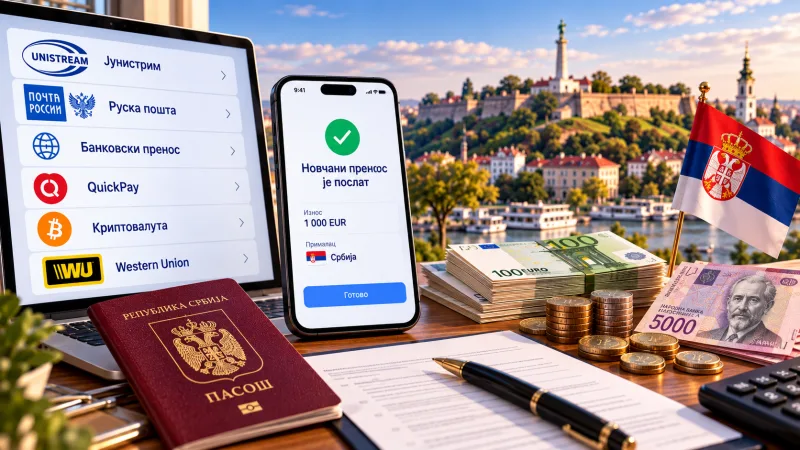
Unistream. The most common option: send money to yourself and collect cash in euros at a branch, then deposit it into a Serbian bank. An important detail from the discussions: send through Unistream's own app rather than through intermediaries — with an intermediary the money is debited while the transfer stalls, and sorting it out is far harder. Another difficulty people report: the SMS code does not arrive during checkout.
Russian Post and Serbian Post. A relative in Russia goes to a post office that handles financial services, gives your name, address and postcode, and you collect the money at a Serbian post office. One participant sent 53,000 roubles and received 57,000 dinars: the stated time is up to three days, his transfer arrived in one day, but the rate is not the most favourable.
Bank transfer. Ares bank does transfers to Serbia; API bank accepts roubles only, and the credit is made after you send documents on the origin of the money — for example, a flat sale contract. If you are expecting a large sum, prepare the documents in advance rather than after the bank asks.
Other options. According to reports, transfers through QuickPay to a Serbian card arrive the next day, but accounts do get blocked. Crypto is discussed as a route to a business account via a Serbian exchange, but that is a single experience with no guarantees. Western Union from a Russian card to cash at a Serbian exchange office is also attempted, but nobody promises stability there.
The main thing to take from these stories: conditions change from month to month, and what worked for one person may not work for another. Check limits, fees and whether a channel currently works with the operator itself rather than relying on chat advice, and avoid intermediaries where you can send the money yourself.