

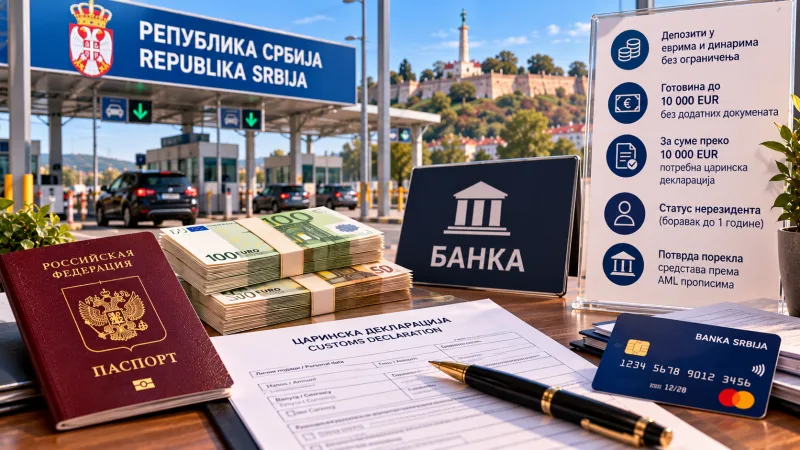
Who is a non-resident in Serbia
A non-resident is a foreigner who has lived in Serbia for no more than a year. Once your stay passes a year, the status becomes resident and the set of rules for the account changes with it. A foreigner who does not live in the country at all is a non-resident too.
Money can be held without restriction
Under the law on foreign exchange operations, a non-resident may hold both foreign currency and dinars in a Serbian bank account without any limit on the amount. The conditions for opening and keeping non-resident accounts are prescribed by the National Bank of Serbia — which is why banks' requirements can differ even though the law is one.
Cash: the 10,000 euro threshold
Under the Serbian Banks Association's recommendations for uniform practice, paying cash into a non-resident account works like this: up to 10,000 euros freely, and amounts above 10,000 euros against a customs confirmation that the cash was brought into Serbia. The same threshold applies to dinars: up to the dinar equivalent of 10,000 euros freely, above that with documents. The practical conclusion is simple: larger amounts of cash brought from abroad are best supported by a customs declaration at the border, otherwise paying them into the account will be a problem.
A change of status must be reported
Once you have lived in the country for more than a year and become a resident, the bank must be told in good time: it changes your status on the documents. This is not a formality — both the tariffs and the set of available operations depend on the status.
The origin of funds and the AML law
Separately from currency rules, the anti-money-laundering law applies. The bank must verify the client and the origin of the funds, so for larger credits it will ask for documents: a sale contract, confirmation of income, a loan agreement. If the origin cannot be explained, the bank may refuse the credit or close the account.
What this means in practice
A non-resident account is not a second-class account: money can be held and received on it. The restrictions concern cash above the threshold, and they are removed by a customs document. So if you plan to bring in a large amount of cash, fill in the declaration on entry rather than trying to explain the money at the branch afterwards.
Data checked on 11 October 2026: the law on foreign exchange operations and the Serbian Banks Association's recommendations for banking practice with non-resident accounts.