

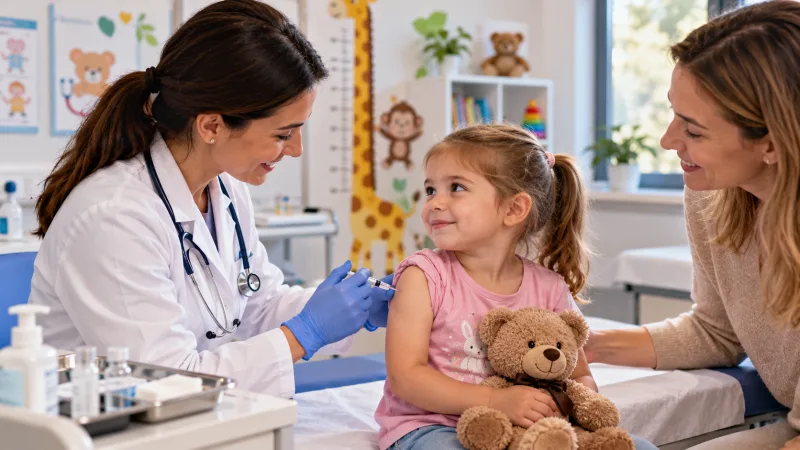
Mandatory immunisation
In Serbia vaccination of children under the national calendar is mandatory, and the calendar is officially updated. The official schedule is this: at birth — the tuberculosis vaccine and the first dose against hepatitis B, in the maternity ward; at two months — the second hepatitis B dose, at the health centre. At three months (after two are completed) — the first dose against diphtheria, tetanus and whooping cough, the first against polio and the first against haemophilus influenzae type b. At three and a half months — second doses of those three vaccines, at five months (before six are completed) — third doses, as well as the third hepatitis B dose.
Then by age
In the second year, at twelve to fifteen months, the vaccine against measles, mumps and rubella is given. At seventeen to twenty-four months — the first booster against diphtheria, tetanus and whooping cough and the first booster against polio. At seven years, before entering first grade — the second booster against diphtheria and tetanus, the second against polio and a booster against measles, mumps and rubella. At twelve years — hepatitis B vaccination for schoolchildren who have not received three doses by then. At fourteen years — the third booster against diphtheria and tetanus and the third against polio.
The paediatrician and routine check-ups
A child is followed by a paediatrician at the health centre for their place of residence. An appointment with a state paediatrician is free with insurance, and the paediatrician keeps the child's record, entering vaccinations, weight, height and examination findings. Routine check-ups follow a schedule: more often in the first months, then less frequently, and before school the child has a systematic examination. It is the paediatrician who issues the certificates for kindergarten and school, and without those documents enrolment cannot be completed.
Vaccines and kindergarten
At state kindergartens the vaccination record is checked on enrolment: vaccinations under the calendar are part of the admission requirements, because this is a matter of the group's epidemiological safety. In practice schools and kindergartens ask for confirmation from the record, and where a vaccine is missing a doctor's document of medical exemption is required, not merely a parent's refusal. Based on the experience of members of Serbian chats, private kindergartens accept children with any vaccination status, while state places are sometimes insufficient even for local citizens, so without a vaccination record admission is hard to count on.
If the child is older and has no vaccinations
The calendar can be caught up: the doctor draws up an individual plan, and an unvaccinated child is brought up to date by age rather than starting from the beginning in the same sequence. That requires documents of previous vaccinations from another country, translated into Serbian, or their absence confirmed in writing. Vaccinations matter for adults too: the tetanus booster schedule applies for life, and certain conditions of work and study require additional vaccinations.
What to expect in practice
Appointments with a paediatrician go through the health centre: larger cities have online booking, but a queue forms for the morning slot from opening time. If you need a Russian-speaking doctor, look in private clinics: appointments there are paid, but without queues or a language barrier, and certificates for kindergarten and school are accepted from private doctors too. Keep the vaccination record in order and translate it into Serbian in advance: at enrolment in kindergarten or first grade that saves weeks. And remember that the vaccination record is a child's medical document for life: without it there is no enrolling and no leaving to study abroad.