

Mandatory and voluntary
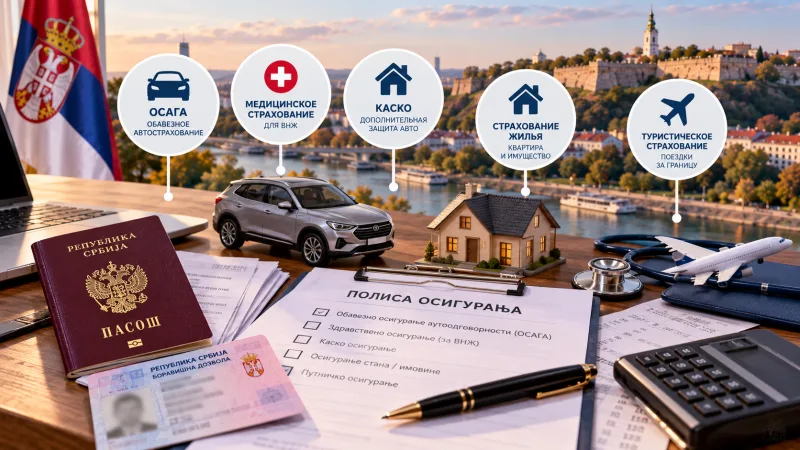
Insurance in Serbia falls into two broad groups. Mandatory is what you cannot do without to register a vehicle, start work or obtain residence status. Voluntary is what a person chooses to cover risks: property, health, liability, travel. Understanding the difference helps to avoid overpaying for what is unnecessary and to avoid being left without protection where the law requires it.
Motor liability
Mandatory third-party liability insurance is the policy every vehicle needs: without it registration is impossible. It covers the damage you cause to other people and their property in an accident: repairing someone else's car, treating the injured, compensation for losses. The price depends on the type of vehicle and engine power, and on the no-claims coefficient: a driver without accidents pays less, the one at fault pays more. For trips outside Serbia a green card is taken out additionally — the international proof of insurance accepted in other countries.
Casco and extra motor policies
Voluntary casco covers damage to your own vehicle: an accident you caused yourself, theft, natural events, vandalism. Beyond casco, insurers offer driver and passenger accident insurance, glass breakage cover and roadside assistance — towing, a technician's call-out, a wheel change. These policies are not mandatory, but on a new car or one bought on credit, casco is often required by the bank or leasing company.
Insurance for status and work
Health insurance is a separate story. With formal employment the worker enters the state system, while applying for residence often requires an insurance policy: it confirms that the person has access to medical care. Policies range from a few thousand euros of cover to tens of thousands, and the price rises with the scope. Practical advice: take a policy that meets the requirements of your ground for residence, and check whether it includes emergency care, hospitalisation and dentistry — many cheap policies exclude dentistry entirely. The policy requirements depend on the ground for residence and on the specific authority: in some cases proof of funds in the account is accepted instead of insurance. Based on the experience of members of Serbian chats, a policy with about five thousand euros of cover cost roughly two hundred euros a year, and for some a confirmation of the amount in the account was accepted instead of insurance. At the same time cheap policies often cover emergency cases only, so the list of risks is worth checking before submitting documents rather than after.
Home insurance
A flat or house can be insured against fire, flooding, theft and natural disasters. Unlike a vehicle, there is no mandatory requirement here, but the risks for a tenant and an owner are significant: a flood from a neighbour, a broken appliance, theft when letting out a flat. Property insurance is often arranged together with third-party liability cover, which covers damage to neighbours. Such policies cost little, while payouts after major incidents considerably exceed the amount paid in.
How to choose and where not to economise
Compare conditions rather than price: the list of covered risks, the deductible, payment timescales and how claims are handled. Cheap insurance with a high deductible and many exclusions often works out dearer than a mid-priced policy with clear terms. When buying a car, keep the previous liability policy details so as not to lose the no-claims discount. And do not forget the annual renewal: a policy past its expiry equals no policy, and driving without valid insurance is a violation, with a fine and extra costs in the event of an accident.