

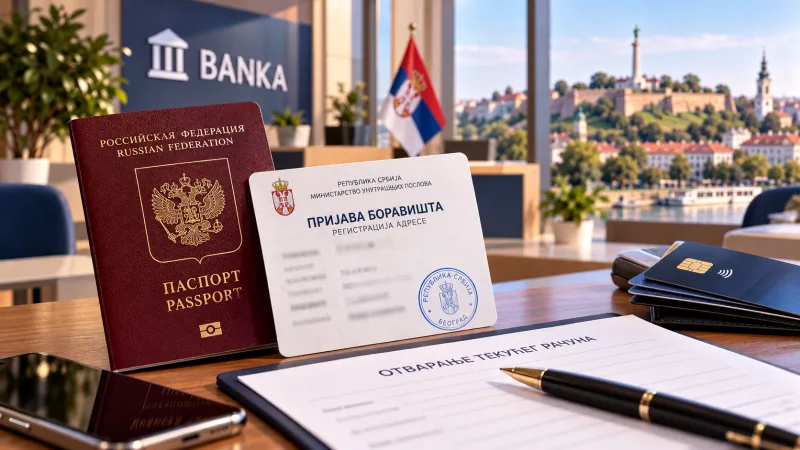
The key document: the 'white card'
For a foreigner at a Serbian bank the key document is not the passport but the so-called 'white card' — a confirmation of address registration issued by the police. Without it an account is, as a rule, not opened: the bank has to see where you live in Serbia. A valid passport is also needed for identification. For citizens of Montenegro, Bosnia and Herzegovina and North Macedonia, banks also accept national ID cards, under agreements between the countries.
Resident and non-resident: the difference
A resident is a foreigner living in Serbia on the same legal basis for more than a year. Both residents and non-residents can open an account, but the bank usually asks a non-resident for more documents. Dinar and foreign currency accounts of non-residents are governed by a separate regulation on the conditions for opening and keeping accounts.
Is an employment contract required?
Some banks may ask for proof of employment in Serbia — a contract with an employer registered in the country. Raiffeisen follows that policy, for example. Others do not require it, among them OTP, Banca Intesa, AIK and Komercijalna. So if you have arrived without a job, it is easier to start with banks that do not need an employment contract.
What to bring
- White card — the address confirmation issued by the police.
- Passport — valid, for identification. For citizens of Montenegro, Bosnia and Herzegovina and North Macedonia a national ID card is accepted instead.
- Proof of employment — if the bank requires it: a contract with a Serbian employer.
How long opening takes
The procedure: you go to a branch with the documents and fill in an application — name, date and place of birth, residence address, identification number. The bank checks the paperwork. The account is usually opened within a few days, though AIK and Banca Intesa report that it can sometimes be done the same day.
If you cannot come in person
A non-resident can open an account through an authorised person: a special power of attorney is drawn up and certified by a notary. On that basis the representative signs the contract with the bank and manages the funds in the account.
What to do afterwards
Once your stay passes one year, your status becomes resident — the bank must be informed. It is worth checking two things in advance: whether the bank keeps a euro account and what cash withdrawals at ATMs cost, since fees differ from bank to bank. And one more: bank tariffs change, so before visiting a branch check the current tariff book on the chosen bank's website.
Data checked on 11 October 2026.
What changed in autumn 2026
Judging by what participants in Russian-language chats reported in October 2026, opening an account has become harder: banks ask noticeably more often about official employment in Serbia. There are reports of refusals without a job at NLB, OTP, Poštanska štedionica, Raiffeisen and Halkbank. At the same time, other accounts say Raiffeisen and Poštanska did open an account — so the outcome depends on the branch and the clerk, not only on the bank.
From the practice in those discussions: Yettel and UniCredit do open accounts, Intesa refuses. In Yettel, according to reports, there is a euro account, deposits, free withdrawals at any bank's ATMs and Google Pay payments, with the account free if a salary is paid in. Alta requires a notarised preliminary purchase contract for a flat — meaning the account is opened for a specific transaction, not simply on request.
API bank (the former VTB) has only three branches in the whole country, and appointments to open an account run far ahead: one report from 9 October was booked for the end of November. In the document list the bank issues, a separate item is a copy of the passport page with the stamp of the last border crossing — such copies are worth preparing in advance, along with a copy of the white card.
For Poštanska štedionica a fresh figure has appeared: on a non-resident foreign currency account the fee is about 0.5 euro a month if there was movement on the account, and if there was none, nothing is charged. Branches scan documents on site and hand them back.
One thing to keep in mind: bank requirements change fast, and what worked a month ago may not work today. So before visiting a branch it is worth asking the community about recent experience with that specific bank and branch — and taking a full set of copies so you do not have to go twice.