

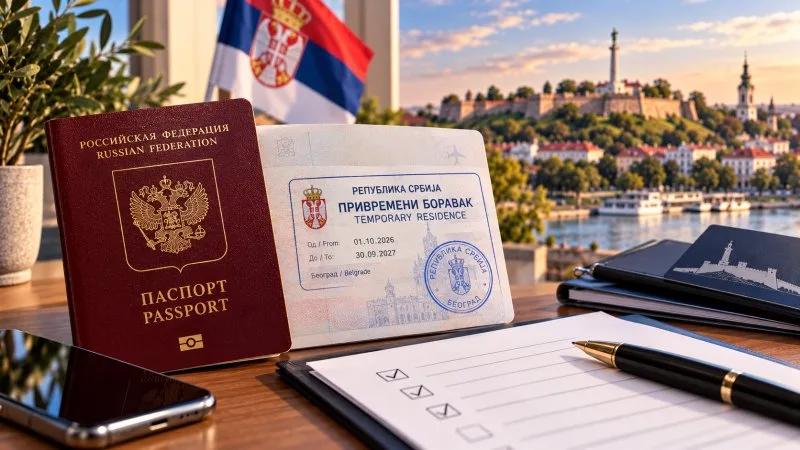
What temporary residence is
A foreigner's residence permit in Serbia is issued as 'privremeni boravak' — temporary residence. The law sets out a closed list of grounds: the status can be obtained only under one of them, and it is not granted 'just because'. The permit is issued as a sticker in the passport or as a plastic foreigner's ID card, in use since 2024; the passport must be valid for at least three months longer than the requested period.
The grounds on which it is granted
The Law on Foreigners lists the following grounds: employment; professional training, further training and internship; scientific-research and other scientific-educational activities; family reunification; religious service; medical treatment or care; ownership of real property; humanitarian stay; the status of a presumed victim of human trafficking and of a victim of human trafficking; and other justified reasons under the law or international treaties.
For how long and how to extend
Temporary residence is granted for up to three years and extended for the same period. In practice the term depends on the ground: three years is granted for property, an indefinite employment contract and your own business, one year for talent, the duration of study for students, and the term of the principal applicant's status for family reunification. It is never granted for longer than the passport is valid: if the passport expires earlier, the term is capped at the passport expiry date minus three months. An extension application is filed at least three months in advance, and no later than 30 days before the current permit expires. If you entered on a D visa, the application for temporary residence is filed within 90 days of your last entry or during the validity of that visa.
What matters about the grounds
The grounds are not equivalent. Employment is the most workable path: it gives both residence and the right to work, which is why most practical questions cluster around it. Family reunification is scrutinised: the law requires refusal where there is reasonable suspicion that the marriage was concluded to obtain status. Ownership of real property gives residence but does not by itself give the right to work — a separate matter that people often confuse.
The duty to live at the registered address
A foreigner who has received residence on any ground is obliged to live in Serbia at the address given when applying and to report changes. Address registration is the very 'white card' without which an account cannot later be opened at a bank or part of everyday services arranged.
What to prepare in advance
The document list depends on the ground, but the principle is the same: proof of the ground, a valid passport with time to spare, confirmation of address, medical insurance and proof of means of subsistence. Check the requirements for each item at the time you apply — they change, and a refusal over a formality costs months.
Data checked on 11 October 2026 against the law on foreigners in force.