

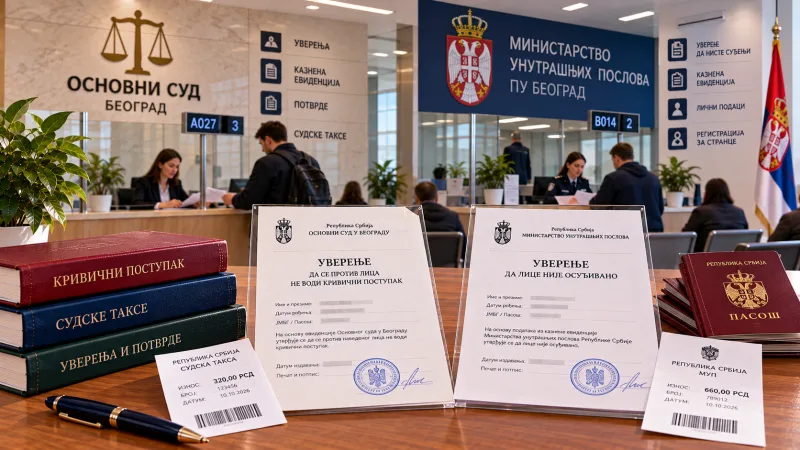
Two certificates that are often confused
Serbia has two different documents and they are easy to mix up. The court certificate confirms that no criminal proceedings or investigation are pending against you — it is usually obtained for permanent residence. The police certificate confirms you have no convictions — it is most often requested for a visa. Both are valid for six months from issue.
The court certificate
It requires residence and at least six months of living in Serbia. It is issued by the court for your place of residence. It costs about 300 dinars plus a small payment commission. In Belgrade it is issued practically immediately, sometimes within minutes; in Novi Sad it takes three to seven days. An important detail people learn at the door: the court admits you only in trousers — shorts, short skirts, tracksuits, flip-flops and headwear are not allowed.
The police certificate
It is issued at the station for your registration address. Unlike the court one, this certificate can also be obtained by people without residence — the white card is enough, as the MUP confirms that residence status is not required for it. The cost is 1,170 dinars, and it takes about five to seven working days. If the certificate is needed for a visa, an apostille is usually placed on it, separately from the certificate, at the court. For Serbian authorities, such as for permanent residence, no apostille is needed.
What cannot be done online
Foreigners cannot obtain the certificate online: the online service works only with a Serbian passport. So allow time for a personal visit. If the certificate is needed for a child, you do not have to take the child along — one parent may go.
A practical note
The certificate is valid for six months, so it is not worth obtaining it long in advance: by the time you file your documents it may already have expired. If you are filing documents abroad, check with that consulate in advance whether certification is required: requirements differ by country, and redoing the certificate means a new visit and a new fee. One more point: the court certificate cannot be obtained until you have lived in the country for six months with residence — that is a legal limit and cannot be worked around.
What to do step by step
Establish which document is required: for permanent residence usually the court one, for a visa the police one. Check your length of stay if you are going for the court certificate. Prepare the documents: an ID or white card and proof of address. Pay the fee and go to the court or police station — to the court in suitable clothes. Collect the certificate and have it apostilled if needed. And check the validity period before filing your documents further.
Data checked on 11 October 2026: types of certificate, timescales, fees and procedure follow current practice and community experience; fees and timescales in individual cities may differ.