

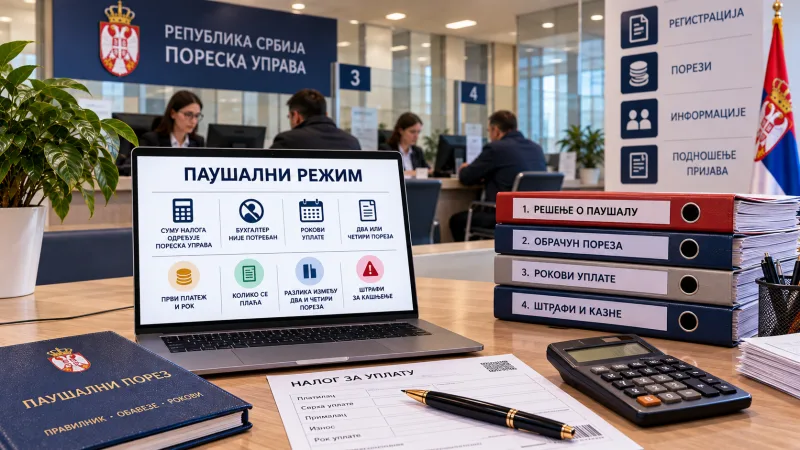
Why the lump-sum regime is popular
Lump-sum taxation is the simplest regime for a small business in Serbia. You do not calculate the taxes yourself: the tax administration determines the amounts and sends a decision listing all the payments and details. An accountant is not required for running such a business, which for many is the decisive argument. There is one limit: the regime applies while annual turnover stays below the set threshold — for 2026 that is six million dinars. Once you exceed it, you must move to another accounting regime.
When the decision arrives and when to pay
A week after opening the business you must obtain the tax decision. It is issued if the business is active and not frozen. The first payment is due by the fifteenth of the month following the month of opening. The amount is proportional to the number of days the business was active: if you opened on 16 November, you will pay less for a partial month, while the deadline stays the same — by 15 December.
You always pay
Two rules that surprise newcomers. First: taxes are paid regardless of whether there was turnover in that month — even with no income, the payments under the decision remain. Second: they are not tied to having a bank account. If there is no money, the obligation is not cancelled, so the regime is worth choosing with monthly minimum payments in mind.
Two taxes or four
The decision usually contains four payments — contributions for pension and health insurance and the related taxes. If you see only two, it means you work or recently worked for a Serbian company: part of the contributions is paid by the employer. After leaving you must put this in order — file a recalculation with the tax office for your business's place of registration or online, after which a new decision with four taxes will appear in your account. If you do not, arrears will start to accumulate.
How to pay and how to check
Payment is possible in several ways: by payment order at a bank or post office, through the mobile apps of banks where you hold an account, or through the tax administration's account. You can also pay for several months at once — simply add the amounts for each tax separately. The best way to check that everything went through and there are no arrears is the tax administration's account: it shows the history of charges and payments. And keep your receipts: in disputed situations they are the first evidence.
What happens if you are late
Since 2023 late payment can attract a fine — from fifty thousand dinars, and two late payments can lead to the business being closed. For a week's delay a fine is usually not charged, but interest accrues regardless. So if you realise you will not manage, it is better to pay at least part and sort out the rest than to let the debt grow.
What else is worth knowing
Beyond the lump sum there is a threshold for compulsory VAT registration — eight million dinars of turnover — after which reporting and value added tax are added, at rates of twenty and ten per cent depending on the category of goods or services. The business registration fee at the APR since the start of 2026 is eight thousand dinars, and the total rate of social contributions is 35.05% of the base. These figures are worth bearing in mind when planning whether you will stay on the lump sum or have to move to the general regime.
What to do step by step
Check that the business is active and not frozen. Obtain the tax decision and work out how many payments it contains. Set up monthly payments — through the bank, an app or the online account. Work out whether the activity fits within the lump-sum threshold and whether turnover is approaching the VAT threshold. Track arrears in the online account and keep receipts. And remember that crossing the thresholds will force a change of regime, and with it an accountant.
Data checked on 11 October 2026: how charges are calculated, deadlines and penalties follow current tax administration practice and community experience; thresholds and rates are revised from time to time, so check them before planning.