

Why it is needed
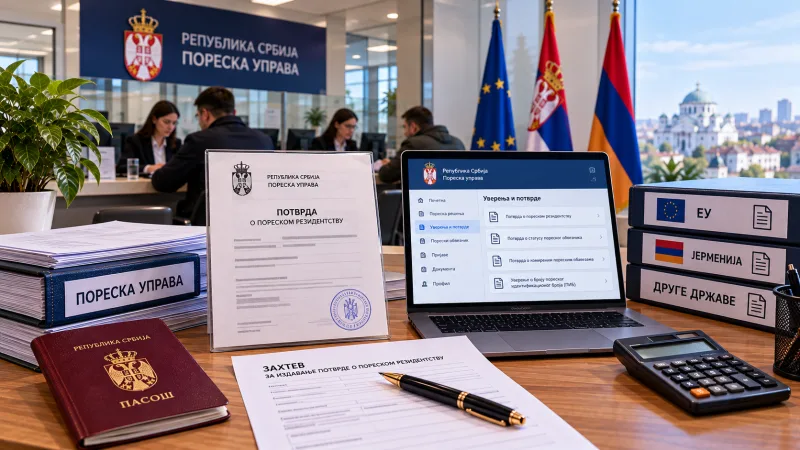
The certificate confirming that your business is a Serbian taxpayer is usually needed not by you but by your client. Companies in the European Union, Armenia and other countries request it to confirm that the contractor really is a Serbian resident and pays taxes here. For some it is an internal reporting requirement, for others a condition for applying the double taxation treaty.
What to understand about the treaty
A widespread misconception: if the countries have a double taxation treaty, no tax need be paid. That is not so. The treaty determines which country and which tax applies to a particular income, and usually means a credit for tax already paid or an exemption, so the same income is not taxed twice. But if the rate in the other country is higher, a top-up of the difference may remain under that country's rules. And not all types of income are covered by the treaty.
How to obtain it
The application is filed in person at the tax office for the place where the business's legal address is registered — online is not yet possible. The processing time is usually about ten working days. The fee for 2026 is 6,410 dinars. The documents are an application form, available at the tax office or printable in advance, a paid fee slip, and an extract from the register of the business registration. The extract is not required everywhere, but some offices insist on it, so it is better to have it with you. The certificate is issued bilingually — in Serbian and English — so no additional translation is needed.
A separate certificate for each country
A detail that often catches people out: the certificate is issued for a specific country. If your clients are in Germany and Armenia, you will need two certificates, two applications and two fees. There is no saving to be had with one 'universal' certificate — the form is completed for a specific country.
Two traps
First: if the business was opened recently, the certificate may be refused. In practice the office often waits for at least six months from the business registration; if the period is shorter, they suggest coming back later. Plan for this in advance if a client expects the document by a certain date. Second, more insidious: if you take the certificate for the current year, you must not freeze the business that year — otherwise next year there will be problems obtaining a new tax residency certificate. So freezing and the certificate sit poorly together.
What to do step by step
Confirm with the client for which year and which country the certificate is needed. Check that enough time has passed since the business registration. Prepare the form, the payment slip and the register extract. Pay the fee and file the application in person at the tax office for your business's registered address. Wait for it to be issued — usually about ten working days — and pass the certificate to the client. And do not freeze the business in the year for which the certificate was issued.
Data checked on 11 October 2026: procedure, timescales and fee follow current tax office practice and community experience; the fee is revised from time to time.