

Who pays
Eco-tax is paid by all types of business: a sole trader on the lump sum, a sole trader keeping accounting books, and a limited liability company. It is not a one-off levy but an annual payment, and it does not depend on your tax system: whether you are on the lump sum or the general regime, the obligation arises for everyone.
When to file
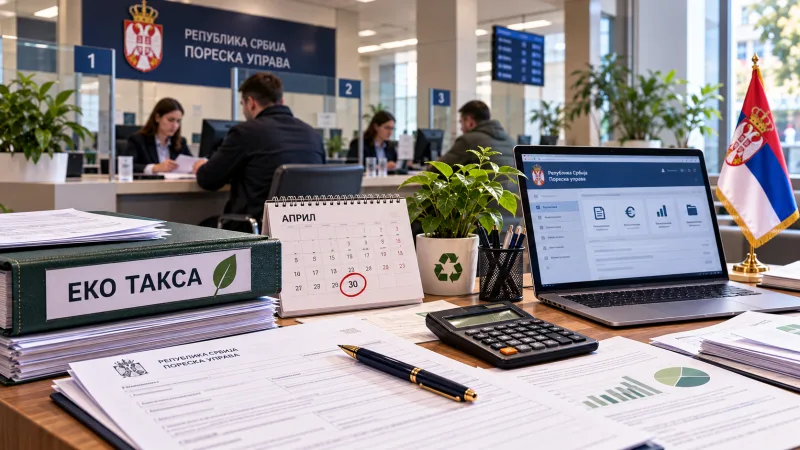
The eco-tax return is filed once a year, by the thirtieth of April. The deadline is annual and does not shift: for 2026 the return is filed by 30 April 2026. Once the tax is assessed it can be paid in one go or quarterly in fixed instalments, whichever suits your cash flow.
What the amount depends on
The size of the eco-tax depends on two things: the scale of the business — micro, small or large — and the degree of environmental impact, which depends on the type of activity. There is a non-obvious point here: even a lump-sum sole trader with no employees may carry on an activity with medium or high impact, in which case the annual amount exceeds five thousand dinars. A sole trader with employees may fall into the 'micro' category with low impact, in which case the amount is around five thousand dinars a year. If you are not on the lump sum, definitely check the calculation with your accountant: there the amount depends on the accounting records, and a mistake in the return costs more than checking.
What to declare when a business is frozen
There are three different situations. If the business was frozen for the whole of last year, a nil return is filed. If the freeze was partial and you are on the lump sum, the return states the amounts from the tax decision for the months the activity ran. If the freeze was partial and you keep accounting books, the income data from the accounting records is used. And one more situation: if the business did not operate a single day in the current year, no return is needed — but if you unfreeze it after the deadline, you have fifteen days to file.
If the deadline is missed
Not good, but not catastrophic: if the business was open before the deadline, file as soon as possible — delay leads to a fine, and interest runs from the date the payment was due. So when the omission is discovered, do not wait: file the return and pay the tax so the debt does not grow.
How to pay and check
Payment goes to the details stated in the decision; if the decision is not to hand, the details can be found in the business's tax account. Checking that the payment is not in arrears is best done in the account too — it shows charges and payments. Keep the receipts: with the tax office, paper settles more than words.
What to do step by step
Establish which category your business falls into by size and activity. Prepare the data: amounts from the tax decision for the months worked, or figures from the accounting records. File the return by the thirtieth of April. Wait for the assessment and choose whether to pay in one go or quarterly. Pay and check there are no arrears in the account. And set yourself a reminder for next year: the deadline is fixed and easily forgotten among other obligations.
Data checked on 11 October 2026: filing deadline, how the amount is determined and the frozen-business procedure follow current practice and community experience; actual amounts depend on the activity and headcount, so confirm the calculation for your business.