

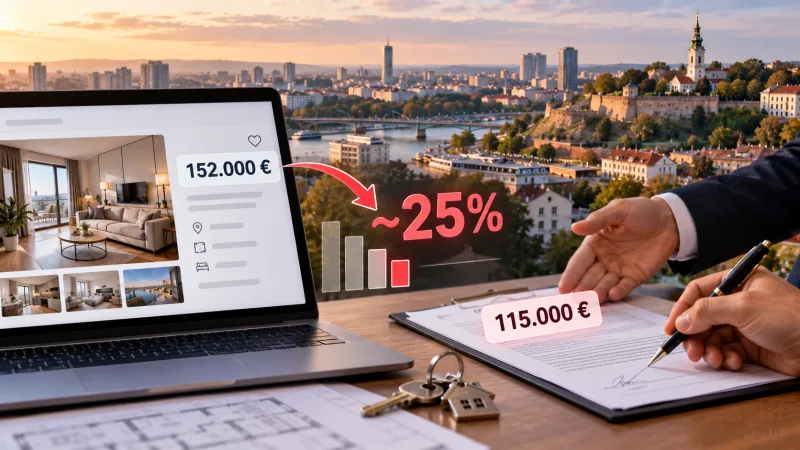
Two prices, not one
The first thing to understand about the Serbian property market: the price in the listing and the price at which a deal actually completes are different figures, and the gap can be large. Listings show what sellers ask, while official statistics record what flats were actually registered for. In Belgrade the gap reaches about a quarter: the average asking price is around 3,340 euros per square metre, while the cadastre data is around 2,690. So when planning a budget, work from both figures at once rather than one.
The numbers by city
Belgrade remains the most expensive: about 3,340 euros per square metre in listings and roughly 2,690 on registered sales. Novi Sad is considerably cheaper — around 2,760 and 2,280 euros respectively. Niš — about 2,010 and 1,570. Kragujevac — approximately 1,890 and 1,340. The difference between cities has a simple explanation: Belgrade and Novi Sad have more jobs, universities and international companies, so demand is higher, while in Niš and Kragujevac the entry price is noticeably lower and the market less active.
New build versus resale
Within the market prices also diverge. New builds are on average more expensive than existing housing, with the difference usually a few per cent — people pay for energy efficiency, a lift, parking and less wear. But resale has its advantages: documents are in place, ownership is already registered, often a better location in an established neighbourhood, and room to negotiate. When choosing, it is worth looking not only at the price per square metre but at what it will cost to bring the flat to the condition you want.
What moves the price
Neighbourhood and transport links come first. Second, the condition of the building and the year of construction: a flat in a building without a lift and with poor insulation is not cheaper for nothing — utility bills there are higher. Third, the floor, the orientation of the windows and whether there is parking. Fourth, and often decisive, legality: premises in unregistered or illegally built structures sell cheaper, but they are hard to resell later and a bank will not lend against them. Fifth, the energy passport, which is mandatory for a property and affects future costs.
Rents for comparison
It also helps to look at rents in order to understand the return. In central Belgrade a flat of 50 to 90 square metres rents for around 700 to 1,500 euros a month. Comparing that with the purchase price gives a rough yield: it comes to a few per cent a year, and that is before deducting taxes, utility costs and void periods. For those buying to let, a calculation for the specific flat matters more than the city average.
Where to look at the data
Look for current listings on the major portals — they are also handy for tracking how sellers' asking prices move. The cadastre publishes official statistics on registered sales, and that is the most reliable benchmark for understanding real prices rather than sellers' expectations. Agency analytics are also useful: they show trends by neighbourhood and property type. By comparing listings with the statistics you will quickly learn to tell a realistic price from an inflated one.
What to do step by step
Set a budget and establish which city and neighbourhood you are looking at. Open the listings and see what is available in that budget. Compare those prices with the statistics on registered sales for the chosen area. Separately calculate the costs beyond the price — tax, notary, commission. If buying to let, calculate the yield allowing for taxes and void periods. And before the deal, check the legality of the property, because a cheap price often hides exactly that problem.
Data checked on 11 October 2026: prices and the gap between sellers' asking prices and registered sales follow current property market statistics; prices change, so check fresh data before deciding.