

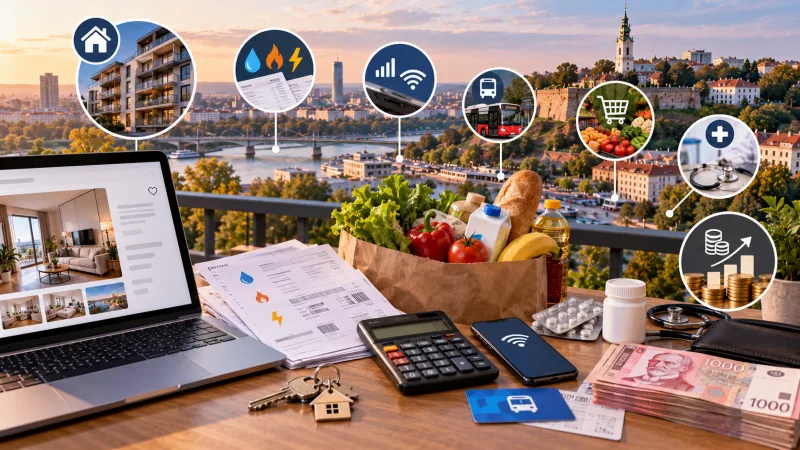
What it costs to live in Serbia
Serbia remains one of the most affordable countries in Europe, but prices are no longer those of 2022: rents rose after the wave of relocations and have held at roughly the same level since. Below are 2026 prices for Belgrade and other cities, so that a budget can be calculated rather than guessed.
Rent
The median price of a one-bedroom flat in Belgrade, according to listings, is around 500 euros a month. For 300–400 euros you can find places in areas further from the centre, such as Mirijevo or Rakovica, though the trip into town then takes longer. A concrete example: a 45 square metre flat with a separate bedroom and a kitchen-living room in Belgrade costs 650 euros. In Novi Sad and Nis rents are markedly lower than in the capital, at the same level of everyday comfort.
Utilities
Payments depend on the season and on how the building is heated. In a 45 square metre flat with central heating the winter bill is around 155 euros, and in summer with air conditioning around 85 euros. Where there is no central heating and the flat is heated by electricity, winter bills can climb to 500–600 euros, so this needs to be checked before signing a lease.
Phone and internet
Home internet costs about 20 euros a month, with speeds up to 500 Mbps on a standard plan. Mobile service runs to about 10 euros per person: usually a package with data and gigabytes for messaging apps. A SIM card can be bought right away, but prepaid numbers in Serbia must be registered, so a passport is required at purchase.
Transport
Public transport in Belgrade has been free for everyone since 1 January 2025: buses, trams, trolleybuses and the city rail service. There are no tickets, no inspectors and no fines for riding without a ticket. A taxi averages 15 euros per trip across the city, car rental 35–45 euros per day, and car sharing around 0.2 euros per minute.
Groceries and food
The average grocery bill for two people is about 300 euros a month when shopping at chains such as Lidl. Food delivery adds roughly another 60 euros. Bread costs from 58 to 200 dinars depending on the type, coffee in central Belgrade around 350 dinars, and in smaller cities it is 10–20 per cent cheaper. Portions in local restaurants are usually large.
Healthcare
State healthcare is practically free: with local insurance a doctor's appointment costs 1–2 euros. That requires Serbian health insurance, and Serbian helps when dealing with state clinics. A private appointment without insurance is about 50 euros, and diagnostics such as an ultrasound or MRI runs to 100–200 euros. Annual insurance with decent cover costs 300–500 euros per person. A gym membership is about 30 euros a month.
Salaries in Serbia
Official data from the Republic Statistical Office: in July 2026 the average salary was 167,402 dinars gross and 121,346 dinars net, roughly 1,030 euros. The average annual salary is 1,813,032 dinars. Salary deductions are 10 per cent tax and 19.9 per cent contributions, with a monthly tax-free minimum of 34,221 dinars. In practice: from a salary of 1,000 euros about 730 euros is left in hand. Annual income above three average salaries, that is above 46,290 euros, is subject to an additional tax.
Monthly budget
For one person in Belgrade renting a one-bedroom flat and buying groceries, about 1,000 euros a month is needed: rent 500, utilities 120, groceries 250, phone 30, the rest 100. For two people the same flat and shared household come to about 1,600 euros, since part of the costs is shared and part grows only slightly. In Novi Sad and Nis the same costs are 15–25 per cent lower, thanks to rent.