

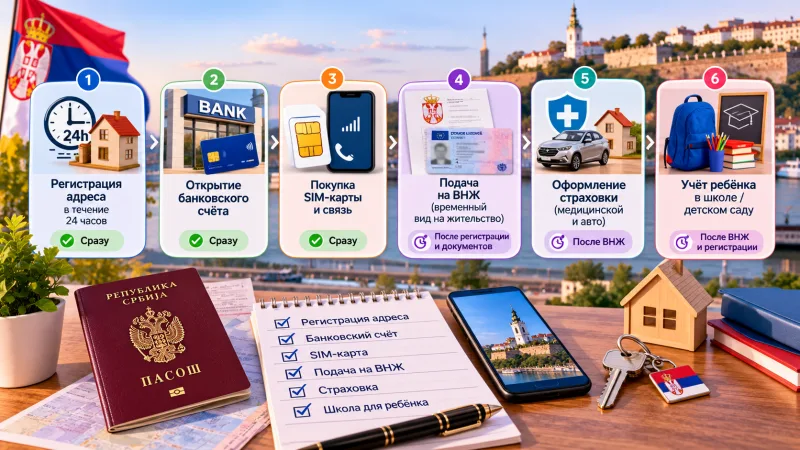
The order of steps after moving
In Serbia almost nothing can be done until the address is registered. That is the first and most urgent procedure, and the bank, SIM card, residence permit and everything else depend on it. Below is an order that saves running around: what happens in the first day, in the first days, and only after the residence permit is granted.
The first 24 hours: registering the address
A foreigner must register the place of stay within 24 hours of arriving at the address, and report a change of address within the same period. Registration is done by whoever hosts you: a hotel handles it itself at check-in, and if you rent a flat the owner signs a statement and you receive a confirmation of registration that everyone calls the white card. It is done at the police station for your place of stay or through electronic services. If you are staying with friends or relatives, they must register you too. A fine for not registering is possible for both the foreigner and the host, so this should not be postponed.
The first days: SIM card and bank account
A SIM card can be bought right away in Serbia, but prepaid numbers must be registered, so a passport is required at purchase. A package with data costs about 10 euros a month, home internet about 20 euros. A bank account is opened with a passport and the white card: that is enough for a basic account and card, while loans and some services require the residence permit. The bank is worth choosing after calculating the maintenance fee for foreigners, as the difference between banks is several times over.
The first month: applying for residence
The application for temporary residence is filed before the lawful period of your stay expires. The grounds vary: employment, your own business, ownership of property, study, family reunification. For property, a permanent employment contract and your own business the permit is granted for up to three years, for study for the length of the course, for talent for one year. Documents are submitted at the police station for your place of residence, and part of the process runs through electronic services. The result is issued as a sticker in the passport or as a separate plastic foreigner's ID card.
Work: only with the permit
Working before obtaining residence is not allowed. Employment requires residence on work grounds and a work permit arranged by the employer. For remote work for foreign companies the ground is different: residence through your own business or through property fits.
Healthcare and insurance
A foreigner has the right to emergency medical care regardless of status. For routine appointments at a state clinic Serbian health insurance is needed, which comes with formal employment. Without it, private insurance is arranged: it is also a mandatory condition for obtaining residence. Annual insurance with decent cover costs 300–500 euros, a private appointment about 50 euros.
Then: eID, diploma, school
Once residence is granted, the eID is issued — access to state services online through the eUprava portal, including tax certificates, address registration and police appointments. If you plan to work in your profession, the diploma must be nostrified: without Serbian recognition the employer cannot register you for the relevant position. A child is enrolled in school before the school year starts, and documents are confirmed with a certified translation into Serbian.
A checklist by deadlines
The first 24 hours — address registration and the white card. The first week — SIM card, bank account, finding a long-term flat, the owner's statement. The first month — the residence application and insurance. After residence — eID, diploma nostrification, school for a child and, if needed, exchanging the driving licence. This order saves time, because every next step rests on the previous one.