

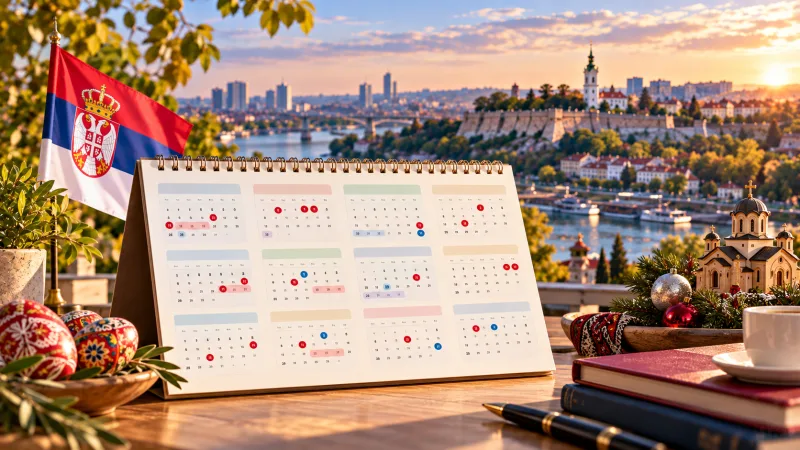
How holidays in Serbia are organised
State holidays in Serbia fall into two groups: those the whole country marks, and religious holidays that are non-working for members of the relevant faiths. If a state holiday falls on a Sunday, the first following working day becomes a day off. That is why the calendar sometimes has more days off than the list has dates.
Non-working days by date
1 and 2 January — New Year. 7 January — Orthodox Christmas, Bozic. 15, 16 and 17 February — Statehood Day, Sretenje; 15 February falls on a Sunday, so Tuesday 17 February is a day off too. 10, 11, 12 and 13 April — Orthodox Easter holidays: Good Friday, Holy Saturday, Easter Sunday and Easter Monday. 1 and 2 May — Labour Day. 11 November — Armistice Day in the First World War, falling on a Wednesday.
Religious holidays of other faiths
The calendar separately marks dates that are non-working for believers of other communities: 3–6 April — Catholic Easter, 20 March — the first day of Ramadan Bayram, 27 May — the first day of Kurban Bayram, 20 September — the first day of Yom Kippur. A person observes the holidays of their own faith, and the employer is obliged to take that into account.
Dates marked but worked
Some dates in Serbia are marked but not taken off: 27 January — Saint Sava, 9 May — Victory Day, 28 June — Vidovdan, 21 October — Remembrance Day for Serbian victims of the Second World War, 22 April — Holocaust Remembrance Day. Ceremonies and concerts are held, but the working schedule does not change.
What this means in practice
When planning trips or booking appointments with the police, a bank or a doctor, it is worth considering not only the holidays themselves but the shifting of days off. The longest break in 2026 is at the start of January, then the February Statehood Day, the April Easter and the May holidays. During those periods state institutions are closed, and private clinics and shops often run reduced hours. Pharmacies and duty services always operate, but on a duty rota published in advance.