

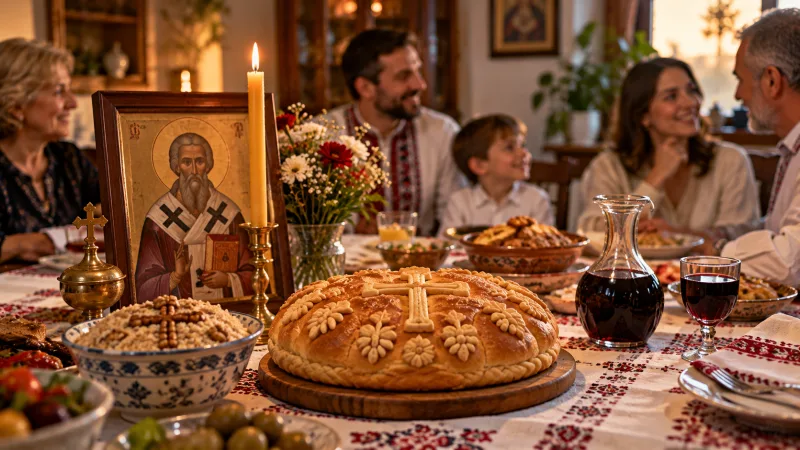
What krsna slava is
Krsna slava is the most important family feast of the Serbs. It is the day of the family's patron saint: each family celebrates the saint on whose day, by tradition, their ancestors were baptised. Slava is not tied to the state calendar, different families keep it on different dates, and it is almost impossible to meet a Serb who does not know their slava date exactly. The feast passes down the male line: a son inherits his father's slava, so within one family it stays for centuries.
Recognition by UNESCO
In 2014 slava was inscribed on UNESCO's list of the intangible cultural heritage of humanity as a living tradition rather than a museum custom. For Serbia that is a particular source of pride: slava is celebrated in families, in villages, in cities and in the diaspora.
How the feast goes at home
In the morning a priest comes to the house: he serves a prayer and blesses water. The centrepiece of the table is the slavski kolac, a round bread with a cross, which the priest cuts and turns together with the host while reading a prayer. Beside it stand zito, or koljivo, made of boiled wheat, a candle and red wine. The candle is lit and burns all day. The table is fasting or rich depending on whether the slava falls during a fast.
Guests and how to behave
Slava is traditionally an open house: there may be many guests, and by the old custom people drop in even without an invitation. In cities it is increasingly arranged in advance, so letting the hosts know beforehand is the right thing. A guest brings a gift or a dish: wine, sweets, coffee, fruit or flowers all work. At the door you congratulate the hosts with the words Srecna slava and wish the whole family good health. At the table nobody hurries: coffee and talk first, then food, then talk again. Leaving right after the meal is not customary, though staying until late at night is not required either.
What not to do as a guest
It is not polite to refuse what is offered, especially coffee and the first toast. Do not extinguish or move the candle — that is the host's job. Do not touch the kolac or the zito before the prayer. And do not ask what it all cost: slava is not about expense but about respect for memory and family.
If you are invited for the first time
It is enough to arrive on time, tell the hosts your own slava or say your family has none, and behave normally. Serbs are warm with guests and do not expect a person to know every custom. If you live in Serbia and are friends with a local family, an invitation to slava is a sign of closeness, and there is no good reason to turn it down.