

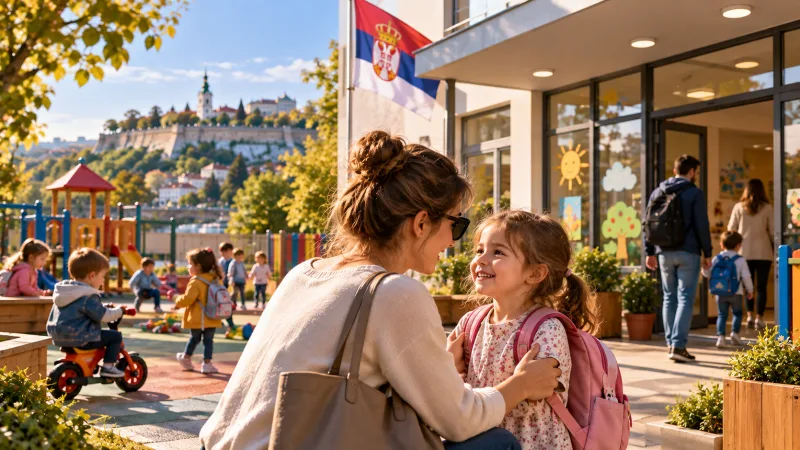
How kindergartens in Serbia work
Kindergartens in Serbia are either state ones, called pre-school institutions and run by cities, or private. Nursery groups take children from about one year old, kindergarten from three, and the final year before school is spent in a compulsory pre-school group, which is free for everyone. Waiting lists at state kindergartens in Belgrade and Novi Sad can be long, so it pays to apply early.
Who can enrol a child
Foreigners apply on the same terms as local residents, but priority depends on whether the child and parents have a registered place of residence and residence status. In practice that means: first the white card and the residence permit, then the kindergarten application. Children of Serbian citizens and children with confirmed status enter the main list, others take remaining places. If there are not enough places, the child goes on a waiting list and a place may free up during the year.
When and how to apply
The main intake is in spring: applications are collected usually from April to May, electronically through the city portal or through the pre-school institution itself. The application is accompanied by a birth certificate, proof of residence, medical certificates and, for foreigners, documents on residence status. Private kindergartens accept documents all year round while there is room in a group, so they are often used as a fallback: the child starts straight away while waiting in the queue for a state place.
What it costs
A state kindergarten is paid for by decision of the city: the institution has a calculated economic cost of keeping a child and a sum the parents pay. For example: in one city the economic price was 24,764 dinars a month, and the parents' share 5,943 dinars, meaning the city covers most of it. Tariffs differ from city to city, depend on the number of children in the family and on parents' income, and there are allowances for large families and children from vulnerable categories. Private kindergartens cost markedly more: from 200 to 700 euros a month for a full day, and in 2026 private kindergartens were raising prices.
What happens in kindergarten
Groups are formed by age, and activities follow a programme that includes Serbian, music, drawing, physical education and outdoor time. For children who do not speak Serbian the first months are an adjustment: the language is picked up quickly, and teachers in larger cities are already used to children from newcomer families. The schedule is usually from 7 am to 5 pm, with meals, a nap and separate play time.
How to prepare
Collect documents and certificates in advance: medical confirmations in Serbia need to be obtained locally rather than translated from old ones. If the child is going to a state kindergarten, check in advance which vaccinations must be confirmed. And keep a Serbian translation of all documents ready — without it the application will not be accepted. Moving from kindergarten to school needs no exams; the child continues schooling where they live.