

Where the system starts
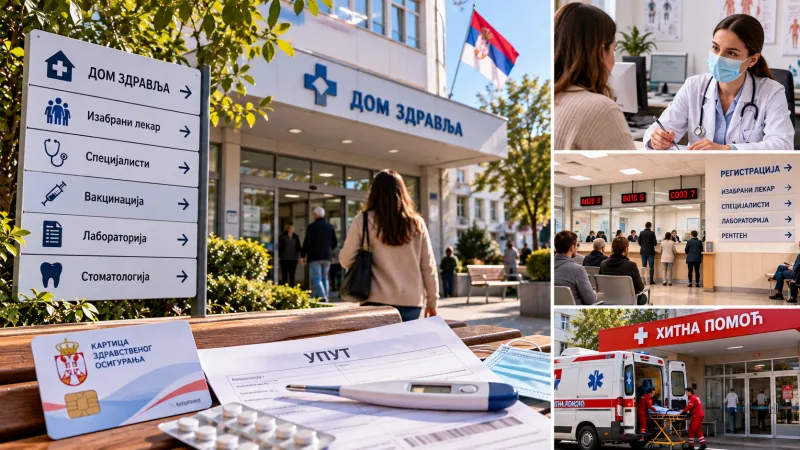
Primary care in Serbia is built around the health centre (dom zdravlja) — the clinic to which a resident is attached by place of residence. The general practitioner is the first person you see: they make a diagnosis, prescribe treatment and, if needed, issue a referral, called an uput here, to a specialist or for tests. Without that referral you cannot see a specialist in a state clinic, except in emergencies or on a paid appointment.
What free treatment requires
Free appointments in the state system require health insurance. It comes with formal employment: the employer registers the worker, who then gains the right to healthcare together with their family. For a foreigner who does not work, insurance is arranged separately or replaced by a private policy, which is also mandatory for obtaining residence. Without insurance, a state clinic will see you only in an emergency.
Emergency care
An ambulance is called on 194 from any phone, around the clock and free of charge. Emergency medical care is provided regardless of status or insurance: this rule applies to everyone in the country. Hospital emergency departments work around the clock, and where life is at risk help is given before any formalities are settled. If the case is not life-threatening but a doctor is needed at once, duty services and private round-the-clock clinics operate.
State and private medicine
State medicine is practically free for the insured: a nominal charge of one or two euros may apply to an appointment. The level is comparable to Russian clinics, but there are queues and bookings, and Serbian or a companion is needed to communicate. Private medicine works without queues, often with Russian-speaking doctors: an appointment costs about fifty euros, and diagnostics such as ultrasound or MRI from one hundred to two hundred euros. Many choose a mixed route: serious cases and hospitalisation in the state system, first consultations in private.
Pharmacies and medicines
Pharmacies are widespread in Serbia and follow a scheduled rota, with duty pharmacies open at night. Some medicines are dispensed strictly on prescription, while over-the-counter ones are sold freely. If a medicine you take regularly is sold in Serbian pharmacies under a different name, ask the doctor to select an equivalent by active substance: that is more reliable than hunting for a familiar name. Prescriptions from abroad are not valid in Serbia.
Practical advice
Arrange medical paperwork right after moving: a file at the health centre, insurance and, if needed, registering a child with a paediatrician. Keep the emergency number 194 and the address of the nearest round-the-clock clinic at hand. If you take medicines regularly, bring a supply for the first months and a doctor's note listing the active substances, so a local doctor can find an equivalent faster. And do not postpone a visit because of language: larger cities have Russian-speaking doctors, and in state clinics medical students and relatives help.