

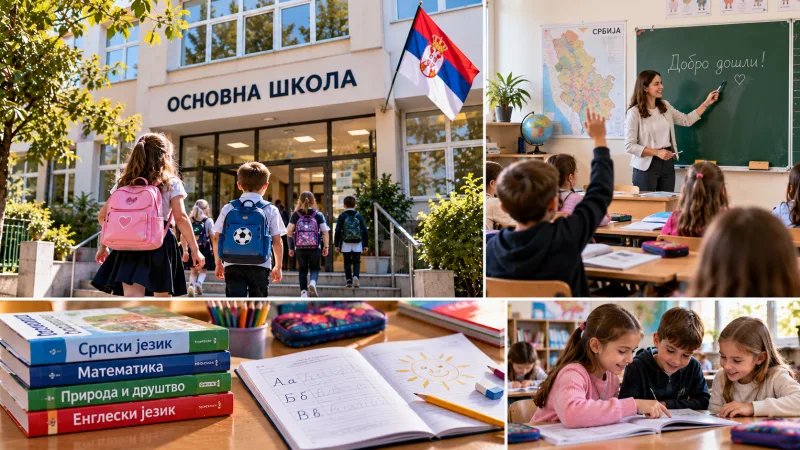
How school is organised
Schooling in Serbia divides into primary school, which lasts eight years, and secondary — four more. The first four grades are taught by one teacher, after which subjects are taught by different staff. After primary school a child goes either to a gymnasium or to a vocational secondary school, and that choice shapes what comes next: the gymnasium points to university, the vocational school to a trade and work.
When and at what age a child starts
First grade takes children who turn about seven by the start of the school year, with a flexible boundary: a child of six and a half may be admitted after a readiness assessment. Enrolment runs in spring, usually in April and May, through the electronic system and the school for the place of residence. It matters to understand: the place of residence confirmed by address determines the school a child is attached to, so registering an address settles the school question too.
Which documents are needed
Enrolment requires the child's birth certificate, proof of address and residence status, a medical certificate of health and proof of vaccinations, plus documents on education already completed if the child is transferring into another grade. All foreign documents need translation into Serbian by a certified court translator, and a school certificate from another country may require nostrification — recognition that the level of education matches the Serbian one.
Classes and marks
In the first grade marks are descriptive only: the teacher assesses progress and conduct in words. From the second grade a numeric mark on a one-to-five scale is added to the descriptive one, where five is excellent and one means unsatisfactory. The school year is split into two terms, and at the end of the year a pupil receives a final mark in each subject. After the eighth grade pupils sit a final exam of three tests: the mother tongue, mathematics and a third subject chosen in December. In 2026 the exam is held on 15, 16 and 17 June.
Children who do not speak Serbian
A child who does not speak Serbian must be helped by the school: additional language lessons are organised, often as individual or group classes in the first months. Practice shows children pick up the language within one term through contact with peers, and younger pupils faster. For parents the more important point is different: check whether the school has experience with children from newcomer families, because that shapes how quickly the child settles in.
Textbooks and costs
For pupils starting primary education there is a free textbooks programme — the right goes to children beginning school in a state school for the first time. In other cases parents buy textbooks and workbooks, which is a noticeable sum by September. School meals are paid separately, with allowances for large families. All practical matters — uniform, trips, excursions — are settled at parents' meetings, and in the first weeks it is worth getting to know the class parents' group: they explain fastest how things work.