

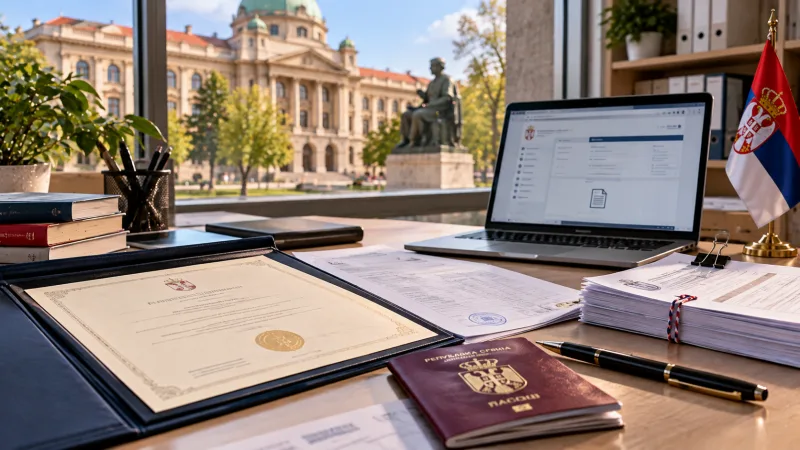
Why a document has to be recognised at all
A Serbian employer or school is under no obligation to understand a foreign diploma: for an education document to have legal force it must be recognised, that is, nostrified. Without it you cannot enrol at a university, move a child into a class, or, for a number of professions, work in your field. Recognition does not confirm your knowledge; it only certifies that the level and content of the education match a Serbian diploma.
Two different types of recognition
The first is recognition for continuing education: this concerns school certificates and diplomas when a person intends to study further or a child is transferring into a school. Such recognition exists so that the university or school accepts the document. The second is professional recognition for regulated professions: medicine, pharmacy, education, law, engineering, certain construction trades. There it is not enough to have the diploma recognised: confirmation of the right to work in the profession and knowledge of Serbian may also be required.
What to prepare in advance
The procedure almost always starts with translations: all documents are translated by a certified court translator, and an ordinary translation is not accepted. You need the original diploma and the transcript with grades, the document on completing the previous level of education, proof of identity and residence status, and confirmation of the fee payment. If a document was issued under a name later changed, proof of the name change is required: a difference in spelling is the most common reason for rejection and return of the file.
How long it takes
The time depends on the type of document and the workload of the authority: a simple check can take a few weeks, while complex cases drag on for months. That is why nostrification is started early, not at the moment documents are submitted to a university or a job starts. If the procedure runs alongside other deadlines — enrolment, extending residence, starting work — a reserve of at least two to three months is needed.
What most often gets in the way
The first mistake is an incomplete package: a missing transcript or proof of the previous level. The second is a translation not done by a court translator. The third is differences in surnames and names across documents. The fourth is trying to get recognition retroactively when application deadlines have passed. The fifth is applying to the wrong body: recognition for study and recognition for work follow different paths, sometimes through different institutions.
How not to lose time
First define the goal: the document is needed for study or for work in a regulated profession. Then check with the chosen university or a future employer which document they will accept. After that assemble the full package, order court translations and file the application. Keep copies of every paper and of proof of posting: if the file is returned, resubmitting with copies goes faster. And remember that recognising a diploma is a separate procedure from residence: one does not replace the other, even when the ground for status is tied to your profession.