

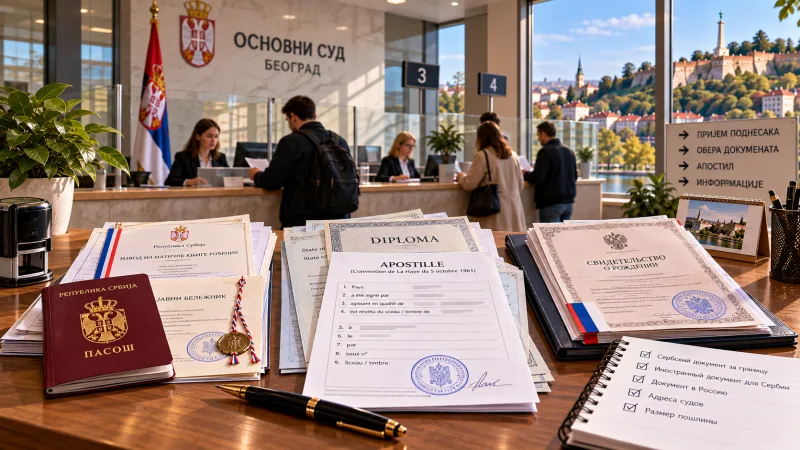
Three situations, not one
The first thing to understand: an apostille is not one procedure but three different routes. A Serbian document is to be used abroad — one case. A foreign document is to be used in Serbia — the second. And the third, the most common for our readers: a document travelling to Russia. Which case you have determines where to go and whether an apostille is needed at all.
A Serbian document abroad
The apostille is placed at the court in the same city where the document was issued. In Belgrade that is the court at Bulevar Nikole Tesle 42 in New Belgrade: reception on weekdays from 8 to 15, a break from 10 to 10:30, and applications accepted until 14:00 in room 18. The fee is paid at the post office inside the same building, in the lobby. In Novi Sad — Sutjeska 3: reception from 9 to 13, on the ground floor by the entrance there is a kiosk where you hand in the papers with the words 'treba apostil', and on the floor above you pay the fee at the post office. Take the original document and a copy; the fee is 3,100 dinars. The application asks for your address in Serbia: give the actual one. The document is usually ready the same or the next working day: it is worth coming towards the end of reception and waiting — everyone is called in at once, so queueing early makes no sense.
A foreign document in Serbia
Here one of three rules applies. If Serbia has a bilateral agreement with the issuing country exempting documents from legalisation, the document is accepted as it is — only a translation into Serbian by a court interpreter remains. For documents from Russia, Ukraine and Belarus no apostille is needed. If there is no agreement, you need either an apostille issued in the country of origin or consular legalisation. The translation in any case is done in Serbia by a court interpreter: translating the document in Russia makes no sense.
A document travelling to Russia
There are two routes here. First, a Serbian notary: fast, but requires a court interpreter's translation, then an apostille at the court, and an additional translation of the Serbian stamps already in Russia. Second, the Russian consulate: the document comes out Russian in form, and in Russia it is accepted as it is, with no apostille and no further translation. The drawback is one: appointments (waiting) which can be weeks or months ahead. So if you will need the document, even not today, it is worth booking at the consulate the moment you realise it.
What to do step by step
Identify which of the three situations you are in. For a Serbian document, go to the court for the place of issue with the original, a copy and the fee payment. For a foreign document, check whether an apostille is required for the issuing country and order the translation in Serbia. For a document going to Russia, decide which is faster in your case — a notary with an apostille or the consulate — and in the consulate's case join the appointment queue at once. And in every option, do not translate documents in advance in another country: only a Serbian court interpreter's translation is accepted.
Data checked on 11 October 2026: addresses, reception hours, fee amounts and legalisation rules per current practice and community experience; fees and schedules change from time to time, so check before visiting.