

Why this is often better than a notary
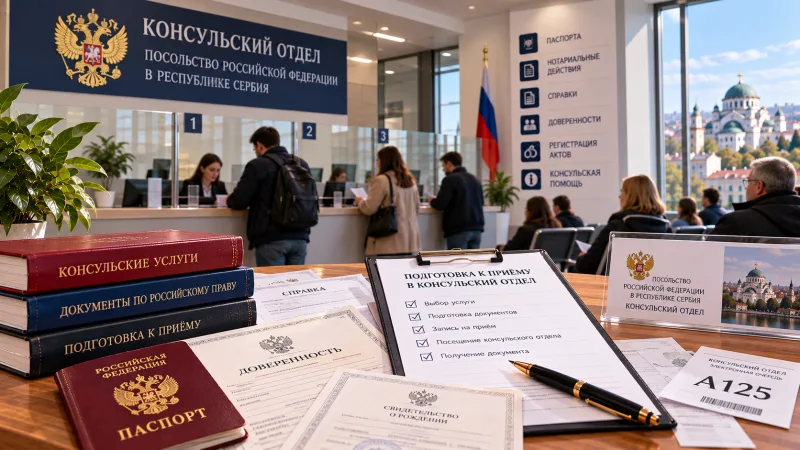
If a document must travel to Russia — a power of attorney, a copy of your residence permit, a lease contract — there are two routes. First: a Serbian notary, then an apostille at the court and translation of the Serbian stamps already in Russia. Second: the consular section, which performs notarial acts under Russian law. The document comes out Russian in form, and in Russia it is accepted as it is, with no apostille and no additional translation. That is noticeably simpler, leaving aside one drawback — the appointment.
What the consular section does
It certifies powers of attorney for representing your interests in Russia, and a completed power of attorney can be sent straight to the relevant Russian notary. It certifies the accuracy of document copies and extracts. It certifies the accuracy of translations from Serbian into Russian and back. It confirms the authenticity of signatures on documents. It certifies consents — for example, for a child to travel or a spouse's consent to a transaction — as well as wills and contracts. It issues certificates, including confirmation of consular registration. And it performs consular legalisation of foreign official documents where the issuing country is not party to the apostille convention.
Where to go and how to book
The consular section of the Russian embassy is in Belgrade at Deligradska 32, open weekdays from 8 to 17. Appointments are by prior booking via an electronic form. A practical point: if you need several services in one visit, for example a certificate and a power of attorney, book them all at once — otherwise you will queue again for the second. And the main thing: appointment slots can be weeks or months ahead, so book as soon as you realise a document will be needed, even if it is not urgent.
What to prepare for a power of attorney
The list depends on the service, but for a power of attorney it is this: an electronic application filed no later than four working days before the appointment — without it you will not be admitted; the text of the power of attorney, uploaded to the system; the principal's valid internal and international passports in original; a legible copy of the internal passport of the person you authorise — the main details and the page with the Russian registration; copies of the documents mentioned in the text. The wording is best agreed in advance with a Russian notary or with the organisation it will be presented to: redoing it from Serbia is slow and costly.
When to go to a Serbian notary
If the document is needed only in Serbia, or deadlines are pressing while no consular slot is free, the Serbian notary works: the visit itself is quick, but a court interpreter's translation, an apostille at the court and, if the document goes to Russia, translation of the Serbian stamps on the spot are added. Count not only the price but the time: the consulate is cheaper and simpler in form, but the wait for an appointment is longer.
What to do step by step
Establish which document is needed and for whom. Check whether the consular section offers it. Book an appointment at once — and for all the services you need together. File the electronic application on time, no later than four working days before the visit. Agree the wording with the Russian side. Gather the passports and copies. And, if time is short, compare with the notary-and-apostille route.
Data checked on 11 October 2026: the list of services, address and requirements per current consular section information and community experience; admission rules and tariffs are updated from time to time, so check the consulate's official information before your visit.