

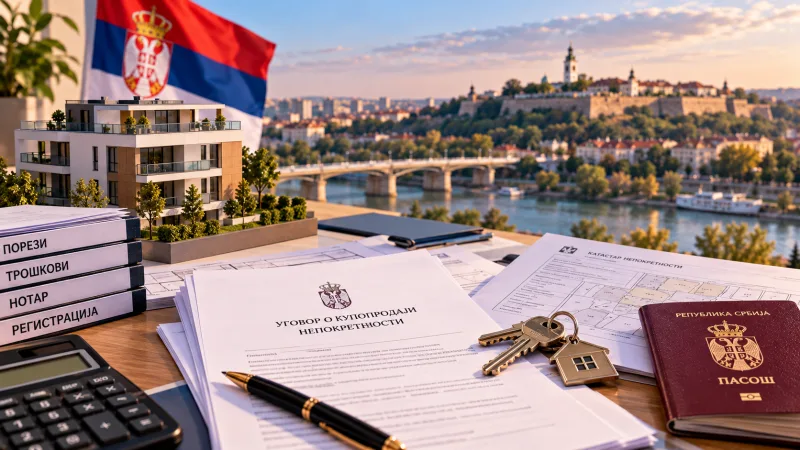
Can a foreigner buy property
Yes, subject to one condition — reciprocity. This means a foreigner may acquire property in Serbia if their country allows Serbian citizens to buy comparable property there. Reciprocity exists with most countries, including the EU, the UK and the US, and the ministry of justice keeps the record of reciprocity with a particular country. The simplest part is flats, houses and commercial premises. The hardest is agricultural land: strict restrictions apply to foreigners there, and a purchase needs separate advice. There is also a workaround used when reciprocity does not help: buying through a Serbian company, since it is a local legal entity and acquires property without a reciprocity check — but that route carries its own costs of maintaining a company and reporting.
Buying a flat and residence: how it actually works
Ownership in Serbia is a full ground for residence, and in practice every owner obtains the status. Under the law on foreigners, temporary residence on the ground of property ownership is granted to a foreigner who meets the general conditions and provides proof of ownership, and the term of that status is up to three years, renewable for the same period. There is no minimum property value, and residence on this ground is granted to every owner, even if you hold only a share of the flat. But two conditions matter: the property must be residential — a house or a flat — and it must be the one you live in. And do not confuse the levels: residence is not permanent residence or citizenship; permanent residence is arranged separately, after several years of continuous status.
There is a practical side too: buying a flat does not remove the procedure. The application is filed through the portal or in person, accompanied by the passport, proof of funds, address registration, insurance and the ownership documents as proof of the ground. But the ground is solid: if the property is registered in your name, the status is renewed on it without difficulty.
The six steps of a purchase
First, checking the buyer's status: citizenship, reciprocity, whether you are an individual or a legal entity, and exactly what you are buying. Second, the tax number: a foreign buyer needs it to register the property, and a lawyer usually arranges it. Third, the most important step, legal due diligence on the property: cadastre status, encumbrances, mortgages, documentary consistency, legality of construction. Fourth, the preliminary contract, usually with a deposit of around ten per cent of the price. Fifth, the main contract, which must be certified by a public notary; if you do not speak Serbian, a court interpreter is needed. Sixth, registration of ownership in the cadastre: until the entry is made you are not the owner.
What it costs beyond the price
On the secondary market the buyer faces transfer tax of 2.5% of the contractual or assessed value. Formally the seller is the taxpayer under the law, but the contract often shifts that obligation to the buyer, so the clause must be read carefully. When buying a new build from a developer within the VAT system, value added tax at 10% applies instead, usually already included in the price, and the first transfer is exempt from the 2.5% tax. Then come the notary's tariff, which depends on the property's value, the agency commission, most often 2–3% plus VAT, legal support if you take it, and a small administrative fee for cadastre registration. The bottom line: add several per cent to the price of a flat rather than rounding 'roughly'.
New build or resale
For a new build, check the construction permit and, above all, the occupancy permit: buying at the construction stage without them is the biggest risk. It is worth reviewing the developer's earlier projects and their data in the register. Payments when buying at the construction stage are made in instalments by phase, and here it is better to choose an escrow account than direct transfers. Resale is simpler: the key point is a clean, unencumbered and properly registered title deed.
Red flags
What should worry you: illegal construction that cannot be properly registered; different people as the owner in the documents and the seller; a mortgage that is not discharged before or at completion; pressure to pay cash before signing a certified contract; a below-market price combined with calls to hurry. Any of these signs is a reason to stop and check everything again.
What to do step by step
Check reciprocity for your country. Obtain a tax number. Commission legal due diligence on the property in the cadastre, including encumbrances and legality. Agree the deposit and sign the preliminary contract. Conclude the main contract at the notary with an interpreter. Pay the tax and register ownership in the cadastre. And only after the cadastre entry treat the flat as yours.
Data checked on 11 October 2026: conditions for foreigners, the registration process and taxes follow current guidance from property lawyers and market practice; confirm rates and tariffs before completing a deal.