

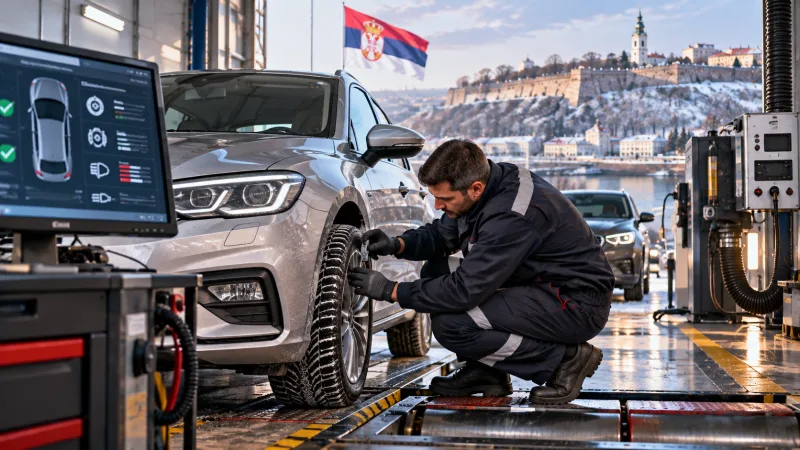
Winter tyres and equipment
Winter tyres in Serbia are mandatory from 1 November to 1 April. The tread depth of a winter tyre must be at least four millimetres on all wheels. The alternative for those who do not fit winter tyres: summer tyres plus snow chains in the boot. The requirement applies regardless of whether there is snow on the road: the inspector looks at the vehicle's equipment, not the weather outside. Fitting winter tyres in summer is not forbidden, but they wear faster in the heat.
The technical inspection and how often
Vehicle registration is inseparable from the technical inspection: you cannot extend registration without a valid technical inspection. The check is carried out at authorised stations, testing brakes, lights, emissions, suspension, and the condition of the body, glass and tyres. If a vehicle fails, the owner has a statutory seven days to fix the fault, and the re-inspection checks only what was found the first time, with no extra charge.
What counts as a fault
The criteria are clear: serious corrosion that has caused perforation of load-bearing parts, the body or the floor is not allowed. Faulty or broken headlights, brake lights and indicators mean an automatic fail. All movable glass, including side windows and the sunroof, must work. Minor damage does not stand in the way: surface scratches, light corrosion, small parking dents and cracked headlight plastic are all tolerated. Small cracks in the windscreen that are not spreading are not a fault either — the problem starts with a large or multiple damage. The rear wiper is not regulated, so its failure is not grounds for a fail.
What changes from 2027
From 2027 the technical inspection in Serbia goes digital. A new central information system for technical inspections runs in pilot mode from June to December, and from 1 January 2027 vehicle registration will only be possible with an automatically generated digital inspection record. Data from measuring devices — the brake tester, the exhaust analyser — will go straight into the system, and the verdict on roadworthiness will be made by a machine on measured values rather than by a person. The system connects to state databases: the eUprava portal, the business register, the mandatory insurance registry and the inspectors' licence database, so authenticity checks become automatic.
What that means for an owner
For a driver little changes: roadworthiness criteria remain the same, and the inspection price does not rise, because the cost of the new system is already included in the current service price. What goes away is the informal arrangement and manual paperwork: the result is produced by the system, and tampering with reports becomes pointless. The practical conclusion for a car owner is one: looking after the vehicle still pays better than relying on arrangements, and registration deadlines should be planned ahead so as not to be left without a valid inspection.
Worth remembering
Prepare winter tyres in good time: before 1 November the queues at tyre workshops and shops are longest and prices higher. Check the registration expiry and book the inspection in advance: at the end of the month and before holidays the stations are busy. Keep the inspection and insurance documents in the car or in electronic form: at a stop they are asked for along with the licence. And remember that winter equipment requirements also apply on mountain roads, where chains may additionally be required in winter.