

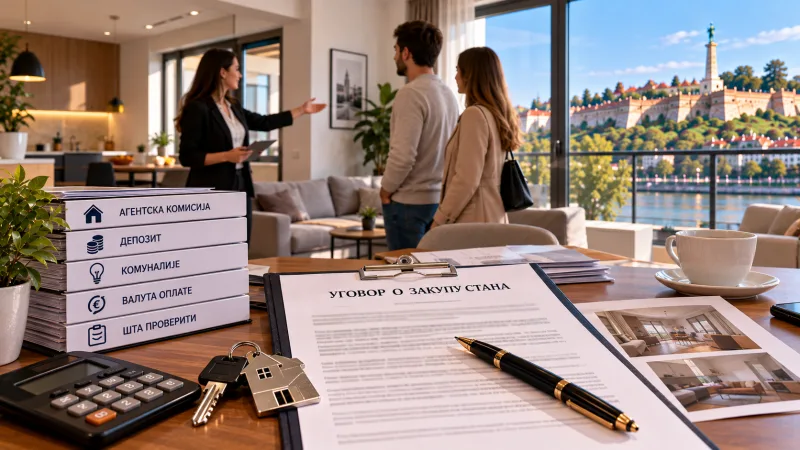
What it actually costs
The basic arithmetic of renting in Serbia is worth understanding up front: the rent is agreed in euros but usually paid in dinars. The agency charges half a month's rent as commission, sometimes up to a full month. The landlord asks for a deposit, as a rule equal to one month's rent. So in the first month you hand over about two and a half monthly amounts: rent, deposit and commission. As a guide, central Belgrade runs from 700 to 1,500 euros for a 50–90 square metre flat; Novi Sad, Niš and the suburbs are noticeably cheaper, and there is more choice on a tighter budget.
Where to look
Listings are browsed on the big Serbian portals — 4zida, halooglasi, nekretnine, cityexpert — and in parallel in communities and chats. In Belgrade most flats are let through agencies, so your contact will usually be an agent. A practical tip: message straight away and ask first whether the flat is still available. Listings often sit for weeks while the flat was let long ago, because the owner advertised it with several agencies.
Neighbourhoods
The centre — Vračar, Stari grad, Dorćol: everything is close but pricier. New Belgrade — modern complexes and new construction. There are also new riverside districts. If you plan to drive, it is worth looking further from the centre or at a house.
What to settle before signing
First and most important: tell the landlord that you will be applying for residence and that you need documents from him, as well as the white card. Some owners walk away at that point, which saves you weeks of negotiation. Ask separately who will register you: sometimes the person showing the flat has no power of attorney while the owner lives abroad. If you want to register the address yourself, ask for the izjava — the owner's permission to register at his address. If you came first and your family follows later, check in advance whether they will be added to the contract and whether the owner can make a white card for them.
Utilities and small costs
Utilities are a separate line in Serbia, and in winter the bill can reach 150 euros and more. Better to agree at once who pays: the ideal is the owner keeping everything in his name while you hand over one amount. Always check the winter utility bill before signing, not after. On the internet, ask where the cable comes in: in older buildings it can be a phone or coaxial line, where speed and stability for calls are worse. If there is no internet, agree that the owner takes the contract in his own name — early termination can carry heavy penalties. One more detail: flats are often let without dishes and part of the appliances, which you will have to buy.
How to pay
The amount is agreed in euros and paid in dinars — simpler, with no need to hunt for exchange offices. An important first-year nuance: a non-resident cannot freely transfer money from his Serbian card to another card. So agree the payment method in advance: cash on meeting, dinars through the bank, or via an ATM if the owner has a card with the same bank.
What to do step by step
Work out the first-month budget including commission and deposit. Pick neighbourhoods and portals, and message agents immediately about availability. At the viewing, check utilities, internet and how payment will work. Before signing, raise residence and the white card and get agreement. Agree the owner's documents and the izjava. Only then sign the contract.
Data checked on 11 October 2026: price ranges and commissions per Serbian listing portals and community practice; exact figures depend on the neighbourhood and the condition of the flat.