

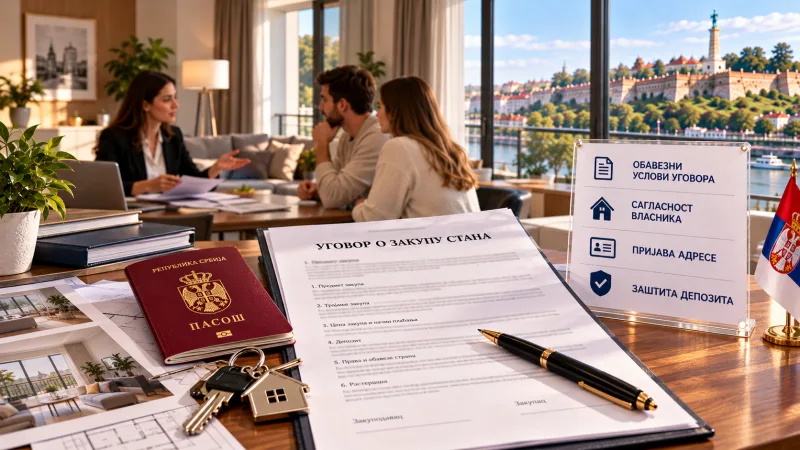
Why you need a proper contract
In Serbia a lease contract is not a formality. For a foreigner it becomes the basis: it is how you are registered at the address, it is required to apply for and extend residence, for the bank and for many everyday matters. A contract signed 'for show' or written on a scrap of paper without details will not be accepted by the MUP.
What the contract must contain
Both parties' details with document numbers, the exact address and description of the flat, the rent — agreed in euros but paid in dinars — the term of the contract, the payment method and the due date. A separate clause on who pays the utilities and what is included in the price. Then the deposit: the amount and the conditions for its return. The notice period for leaving: most often one month, and that term is better seen in the text than remembered from a conversation. And the right to register you at that address — which is precisely the consent for the white card.
A bilingual version saves money
A useful trick: draw up the contract in two columns from the start, Serbian and Russian, and ask the owner to sign that version. Such a contract is later accepted without translation, and translation costs money — sometimes more than it appears at first glance. The same bilingual contract is also useful in other procedures requiring a translation into Russian.
Which documents to get from the landlord
A copy of his ID card or passport. A document proving the flat is his: a cadastre extract or a purchase contract. If he cannot come to the police himself, an izjava will be needed — written permission under which you register the address yourself. And if the flat is not handled by the owner himself but by someone under a power of attorney, ask to see that power of attorney: without it the registration cannot be done.
Registering the address
Under Serbian rules the person who provides accommodation registers the occupant, and there are 24 hours to do so. If the owner does not or cannot, you do it yourself under the izjava. A good rule: settle the white card before you hand over the money, not after you have moved in.
How to protect the deposit
When moving in, record the condition of the flat and its contents: photos of the rooms, furniture and appliances, meter readings, and a list of what comes with the flat. This removes almost every dispute on moving out. And check in advance within what period and on what terms the deposit is returned: the practice is return on moving out, allowing for any damage.
Taxes and paperwork
Rental income in Serbia must be declared by the owner — that is his task, not yours. But the consequence for you is direct: if the rental is nowhere recorded, the owner has no reason to bother with your registration and documents, and you will have no paperwork for the MUP. So insist on an ordinary written contract with full details — it protects both sides.
What to do step by step
Agree with the owner before paying: that he will register you and provide the documents. Obtain a copy of his ID and proof of ownership. Sign a bilingual contract listing all the terms, including utilities, deposit and notice period. On moving in, photograph the flat and note the meters. Get the izjava if you register yourself, and only then consider yourself an official tenant.
Data checked on 11 October 2026: requirements for the contract, registration and documents follow Serbian rules and community practice. Check the specifics locally: different police stations have their own nuances.