

How it worked
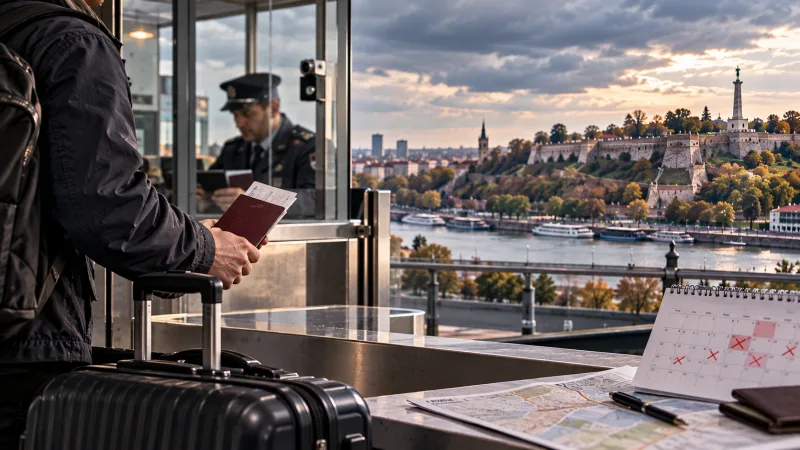
Russian citizens may stay in Serbia visa-free for 30 days per entry. The scheme known as a visa run was simple: once a month you left — most often to Bosnia and Herzegovina, sometimes to North Macedonia or Montenegro — and came straight back. The clock restarted, and so a person could live in the country for years without applying for residence. It was mass practice, not isolated cases.
What changed in 2026
Serbia has set a course to align its visa policy with European norms by the end of 2026 and has begun applying the 90-days-in-each-half-year rule. For the routine of constant exits this is fundamental: the same country may grant 30 days per entry, but total visa-free stay within 180 days is capped at 90 days.
How this looks in practice
Court decisions have started to appear. One example is a ruling by the court in Subotica in March 2026: the court held that, despite the formal exits, the person had in fact lived in Serbia for a long time, and imposed a fine together with an order to leave the country. There are also accounts of checks at which a person's passport and phone were taken, an immediate fine was offered and detention was threatened on refusal, while the departure order itself was issued under an accelerated procedure and declared not subject to appeal.
Why this affects tens of thousands of people
As of early 2025, between 80,000 and 110,000 Russian citizens were living in Serbia, and only about 67,000 of them had a formal right to long-term residence. The rest lived partly thanks to such exits. Once the rule is applied, staying without a residence permit becomes precarious.
The white card trap
A separate difficulty concerns address registration. A new white card is not issued without the previous one, so the deadlock cannot be escaped by simply trying to register the address again. That is exactly why many turned to regular exits — and exactly why it now matters not to let your status lapse.
What to do instead of a visa run
A visa run remains only a short respite, not a way to live in the country for years. If you plan to stay, you need a ground for residence: an employment contract with a Serbian company, your own business or freelance work, property, study, family reunification, talent. The application is worth starting early rather than waiting for a check: a status decision takes weeks and months, whereas a departure order is issued under an accelerated procedure with no right of appeal.
What to do step by step
Count your days of stay and see how much margin you have under the 90-in-180 rule. Check whether your white card is still valid and whether the address matches reality. Choose a ground for residence and start gathering documents. Keep your passport, registration and proof of the ground to hand. And in a complicated situation do not resolve it with another exit but consult a lawyer: the rules change quickly, and the consequences — a fine and a demand to leave the country — arrive without lengthy proceedings.
Data checked on 11 October 2026: visa policy changes, examples of court decisions and statistics follow publications about the new requirements and data on the number of Russian citizens in Serbia. The situation is changing, so before deciding, check current information and take legal advice.