

How the system is organised
Education in Serbia is divided into preschool, primary and secondary. Primary school lasts eight years in two cycles: from first to fourth grade almost all subjects are taught by one teacher, and from fifth to eighth by different subject teachers. Primary education is by law compulsory and free, and secondary education is free. Schools may be state or private, including international ones offering the International Baccalaureate and Cambridge programmes.
Age and first-grade enrolment
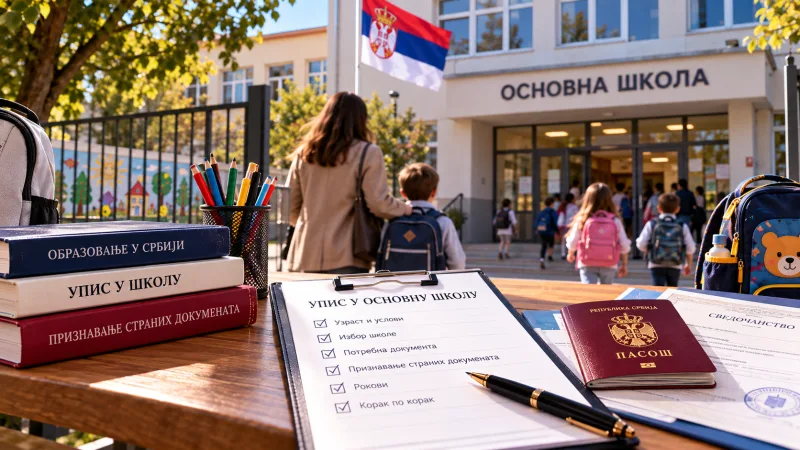
First grade takes a child who turns at least six and a half and at most seven and a half by 1 September. A school must enrol any child living in its area, but parents have the right to choose the school: the request is submitted no later than 1 February of the enrolment year. There are no entrance exams, except at music and ballet schools, but a school psychologist assesses the child's readiness — if necessary, enrolment can be postponed by a year. Enrolment can be done online through the government services portal, in the electronic appointment system, and then everything is completed with a single visit to the school.
Which documents are needed
The child's birth certificate, address registration and documents of previous education. If the child has already attended school in another country, you need the document from the previous school translated into Serbian by a court interpreter, and the procedure for recognising the foreign school document at the Agency for Qualifications. It is sensible to start that procedure early: without it the child will not be placed in the appropriate grade.
Kindergarten
Preschool education is also well organised: enrolment in a state kindergarten is done electronically through the government services portal. If the parent is a foreigner and there are no data in the central register, a separate online service exists for such cases — personal documents such as the birth certificate are pulled from the registers by the authority itself. Places in state kindergartens may be scarce, so submit the request at once and consider several options, including private and international kindergartens.
Serbian language
The language is a separate question. Children usually pick up Serbian faster than adults, but the first year can be hard. Lessons and simple practice apps help: there are programmes for learning Serbian and the Cyrillic alphabet, designed for children among others. It is useful to agree additional support with the teacher in advance: schools treat a new pupil more attentively when they know another language and another curriculum lie behind them.
Secondary school and beyond
Secondary school entry follows the final exam in primary school. The ranking uses grades in the sixth, seventh and eighth grades, the final exam result and competition results. Enrolment in state secondary schools goes through the 'My Secondary School' portal, and for certain gymnasiums and arts schools an entrance exam is added. If the child finished school abroad, the secondary education document is recognised at the Agency for Qualifications as well.
What to do step by step
Check the child's age and the enrolment deadline, and if needed submit a school-choice request by 1 February. Gather documents and order translations of the school papers from a court interpreter in advance. Start the recognition of the foreign school document. Enrol the child online through the government services and visit the school once. For a younger child, apply for kindergarten and consider several options straight away. And tackle the language from the first weeks rather than waiting for problems at school.
Data checked on 11 October 2026: enrolment rules, age and the document recognition procedure follow official information for people moving to Serbia and community practice; confirm specific deadlines with your chosen school.