

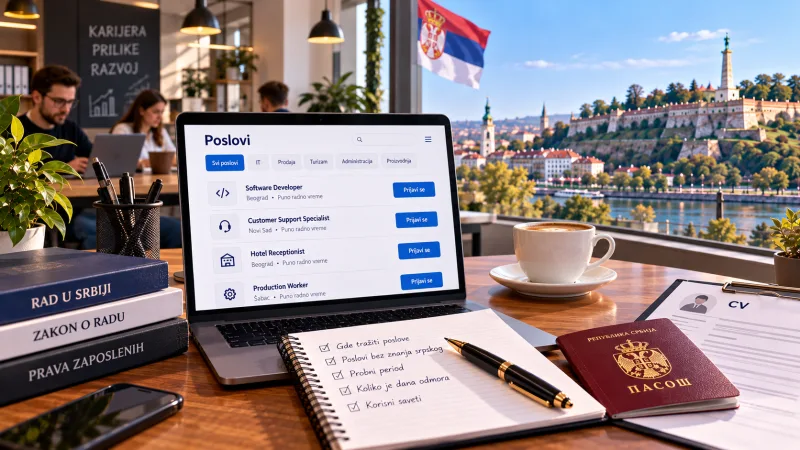
Where to look for work
The main Serbian job portal is Infostud, which has separate sections for companies and candidates. Second is Poslovi, followed by sector-specific sites and LinkedIn, which is especially useful for roles in international companies and in IT. Beyond the portals, communities work actively: groups on social networks and messengers where vacancies appear before the portals. And there is a separate channel — approaching companies that interest you directly: in Serbia this works and is not considered inappropriate.
Sectors where your language is no barrier
Serbian is not required where the company serves an external market: IT and development, customer support in foreign languages, outsourcing and service centres, international companies with offices in Belgrade and Novi Sad, and engineering or technical roles on foreign projects. In such places English becomes the working language and Serbian comes with time on its own. In state bodies, retail and local small business, Serbian is needed from day one.
What matters about your paperwork
For a foreigner, working in Serbia involves a permit, and here the single permit rule applies: it combines the work permit and the ground of stay, is usually issued for up to three years, and ties you to your employer. If you change employer, you go through the procedure again rather than simply moving to another company. So it is worth agreeing the paperwork before signing the contract, not after — a good employer does this itself without reminders.
Contract and probation
The standard employment contract is the ugovor o radu: indefinite or fixed-term. Separately there are contracts for work and for temporary or seasonal jobs, with fewer guarantees: they do not give the same service record or leave. A probation period is allowed and may last up to six months. If you are offered only that form for permanent work, ask why: sometimes it is a saving on contributions, and it affects your service record and your right to insurance.
What the law guarantees
The minimum hourly rate for 2026 is 371 dinars net per hour, and paying less is not allowed. Leave — at least 20 working days a year, plus public holidays. The employer must pay contributions on the full salary, and they count towards your service record and future pension. Salary must be paid no later than the date set in the contract, and for delays an employee may complain to the labour inspectorate.
How to search effectively
Write your CV in English straight away and add a Serbian version as needed. Attach a short cover letter to each application, because popular roles attract hundreds of replies. Do not ignore recruitment agencies: in Serbia they work with both local and foreign companies. And track which companies are opening offices in the country: new centres hire in batches, often without requiring Serbian.
What to do step by step
Decide what suits you better: the local market with Serbian, or the international one with English. Prepare an English CV and a LinkedIn profile. Set up alerts on Infostud and Poslovi. Join sector communities. When replying to a vacancy, check the form of employment and the company's willingness to handle the permit. And before signing the contract, understand how the salary is calculated — there is a separate article on taxes and contributions.
Data checked on 11 October 2026: minimum labour rate, leave requirements and the paperwork procedure per Serbian labour law and community practice; specific terms are always set in the contract.