

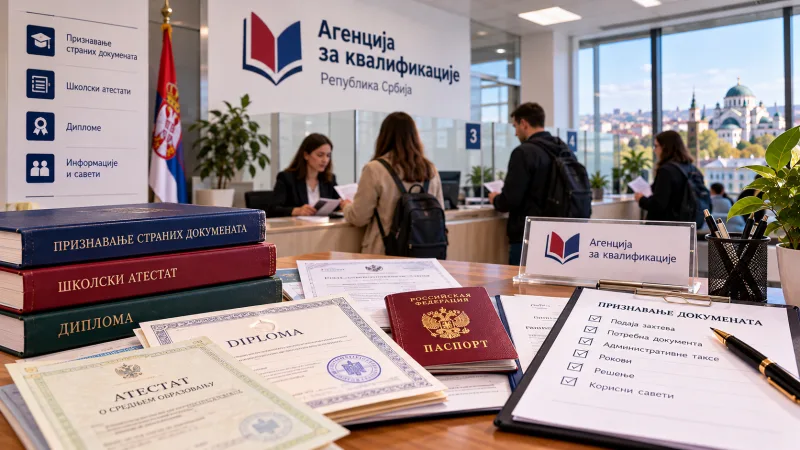
What nostrification is and why it is needed
Nostrification is the recognition of a foreign education document: confirmation that it has legal force in Serbia. It is needed in several situations: for a child to be placed in the right grade, to continue studying, to work in your profession — as a doctor, for example — and to apply for residence on the ground of talent. Without recognition, the document in Serbia is simply a piece of paper from another country.
Who handles it and where
Recognition is handled by the Agency for Qualifications, which runs the system for recognising foreign education and, for higher education, works through its information centre. It is important to understand that the procedure takes place only in Serbia — a Serbian nostrification decision cannot be obtained in Russia or any other country. A school document and a higher-education degree follow different procedures, with different forms and different fees.
School certificate
The application is filed by the parent or guardian, or by the adult person concerned. There are two ways to file: in person in Belgrade or online, with a separate form for each level. Fees differ: for documents of completed grades 1–9 — 6,100 dinars, for 11 grades or college — 8,900 dinars. If someone other than the parent files, a certified power of attorney is required, and the address in the application is a Serbian one — the decision is sent there.
Higher-education diploma
Here the procedure is stricter. Filing is via an online form, and the result is collected only in person in Belgrade and only within 30 days. If you do not come within that period, the decision goes to the archive and may not be retrievable: you have to file again and pay the fee a second time. With a school certificate it is easier: if you chose personal collection and did not come, the decision is still sent by post to the address given.
Documents and one practical nuance
You need the education documents and their translation into Serbian by a court interpreter. A practical detail people discover at the last moment: the fee and the interpreter's work cannot be paid with a card issued outside Serbia. So it is worth deciding in advance how you will pay, and not planning to file on your first day after arriving.
When to file
There is a temptation to file for diploma recognition before moving. In the community's experience this is usually money wasted: the procedure's timescale is comparable to finding a flat and opening an account, and all of it can be done in parallel, once you are there. But with a child's school documents, haste is exactly what is needed: without recognition the child will not be placed in a grade.
What to do step by step
Establish whether your case is a school document or a degree. Gather the documents and order a translation from a court interpreter. Decide how to pay the fee, bearing in mind that a non-Serbian card will not work. File the application: for school — in person or online, for a degree — online. Track the status and collect the decision — in person in Belgrade or by post, depending on the procedure. And do not delay collection: the deadlines exist precisely so that decisions do not sit in the archive.
Data checked on 11 October 2026: fees, filing and collection procedure per current practice of the Agency for Qualifications and community experience; fee amounts are revised from time to time, so check them before filing.