

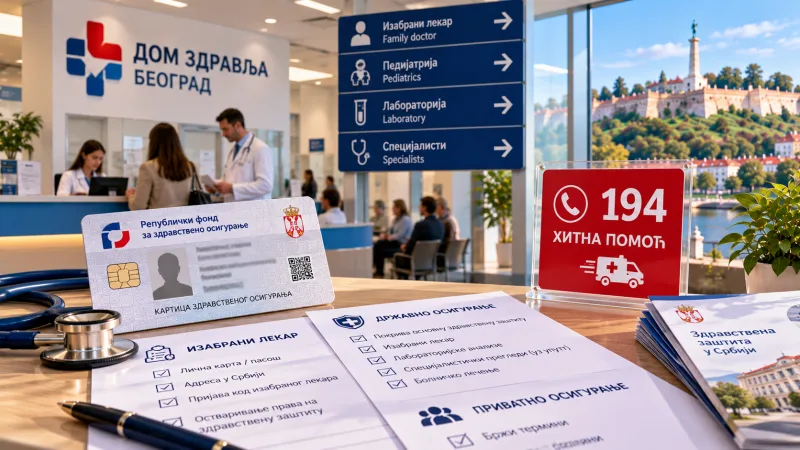
A foreigner has the right to care
This is not a matter of luck: the law on health care states expressly that the right to medical care belongs not only to a Serbian citizen but also to a foreign national permanently living or temporarily staying in the country. So a refusal along the lines of 'we do not serve foreigners' in the state system is not normal practice but a breach of the rules.
An emergency: 194
The ambulance in Serbia is called on 194. That is the number to save in your phone straight away, because in a stressful situation there is nowhere to look it up. When calling, it helps to give the exact address and the nearest landmark: city, street, house number, floor and door code, plus a short description of what happened.
The family doctor
The main entry point into the system is the family doctor — izabrani lekar — at a Dom zdravlja health centre. It works like this: each centre has a list of doctors, you pick yours, and on the first visit you fill in and sign a declaration of choice. An important detail: that declaration renews automatically every calendar year unless you decide to change doctors. So there is no need to reconfirm the choice each time. If your doctor is temporarily away, another one sees you.
State insurance
If you have state health insurance arranged, you receive an insured person's card, attach to a doctor, attend the health centre and get medicines on reduced-price prescriptions. The family doctor also issues referrals to specialists: in Serbia you usually go to a specialist with a referral rather than directly.
Private policies and clinics
At the same time, private clinics and policies are widely used in Serbia. Such a policy covers treatment at private clinics, and for many people it is faster: an appointment with a private doctor can be had without waiting, and sometimes you can simply walk in. The downside is that cover is limited to a list of clinics and a set of services, so before buying a policy read exactly what it pays for and what it does not.
Pharmacies and medicines
Pharmacies are everywhere. Some medicines are dispensed only on prescription: prescription drugs are not given without a doctor's order, and antibiotics especially not. If the doctor issued the prescription electronically, it is visible in the system, so at the pharmacy it is enough to give your name and insurance card number — carrying paper is not required.
What to do step by step
Save 194 in your phone. Decide whether you are going the state route or through a private clinic. If state: arrange the insurance card and choose a family doctor at the nearest health centre. If private: check in advance which clinics work with your policy and whether there is a 24-hour service. And keep a minimum at home: something for fever, for pain and for poisoning — you do not want to go looking for a pharmacy at night.
Data checked on 11 October 2026: the right to medical care per the law on health care; the procedure for choosing a family doctor per the rules of health centres.