

What it is
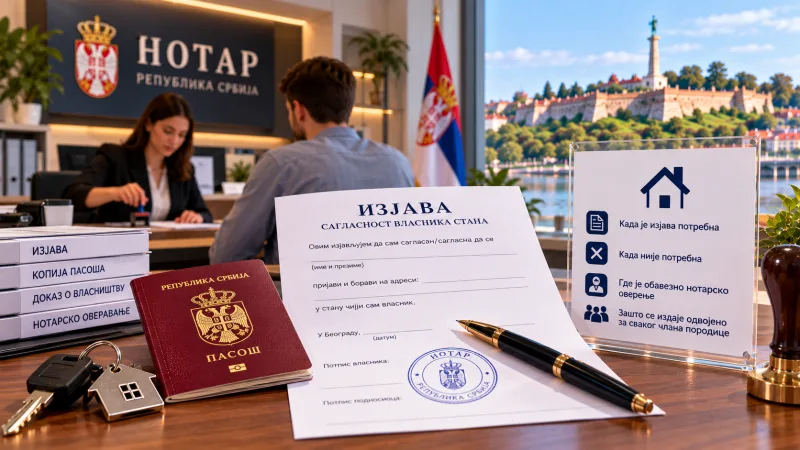
The izjava is a statement in which the flat owner permits you to register and live in their property. It replaces or supplements the lease contract in procedures where the MUP wants to see the owner's written consent. If you live in your own flat, no izjava is needed: a proof of ownership or a cadastre extract is attached instead.
When it is needed
Three main situations: arranging the white card yourself without the owner — then the izjava is mandatory and must be notarised; changing the address under residence or permanent residence; and renewing documents after replacing your passport, because the izjava contains the passport details. In Belgrade and Subotica the izjava is often attached instead of the lease contract, while other cities more often ask for the contract.
One for the family or separate ones
Practice: it is more reliable to make a separate izjava for each person, children included. Sometimes the MUP accepts one for the whole family, but it can also demand a separate document for each member — so a family of three makes three izjavas. Each names only one person.
Is a notary required
It depends on the procedure. For the white card and for changing the address under permanent residence, notarisation is mandatory. For applying for residence and permanent residence it is usually not required. Importantly, the owner can have the izjava certified alone, without you present — you do not have to go to the notary together. And if an inspector suddenly demands a notarised izjava, you have eight calendar days to have it certified and brought in.
What to attach to the izjava
A copy of the owner's identity document. If there are several owners — an izjava and a document copy from each. If the flat belongs to a company — the director signs, the company's details are given, and an APR register extract is attached. If the owner is a foreigner — the document on which the property is registered; if a Serbian owner has no ID card to hand, a copy of the passport page with photo and name will do. Plus a document proving ownership: a purchase or inheritance contract, or a cadastre extract.
Validity and language
The izjava has no expiry: it stands until the flat changes or your passport changes. After replacing your passport the izjava must be made again with the new details. It can be filled in by hand or on a computer, and passport details are written in Latin script exactly as they appear in the passport.
What not to do
People sometimes suggest adding a clause to the lease contract instead of an izjava. Better not to: the MUP may then demand notarisation, and a single page cannot be certified — the entire contract would have to be. It is simpler to make a separate izjava on the template straight away.
What to do step by step
Work out which procedure you face and whether a notary is needed. Ask the owner to fill in the izjava — a separate one for each family member, with passport details in Latin script. Attach a copy of their document and proof of ownership. If the procedure requires certification, the owner certifies it themselves. And keep the document with your papers: it will be needed again when you change address or passport or extend your status.
Data checked on 11 October 2026: requirements per MUP rules and community practice; whether certification is mandatory depends on the procedure and is confirmed when applying.