

Why an ordinary translation will not do
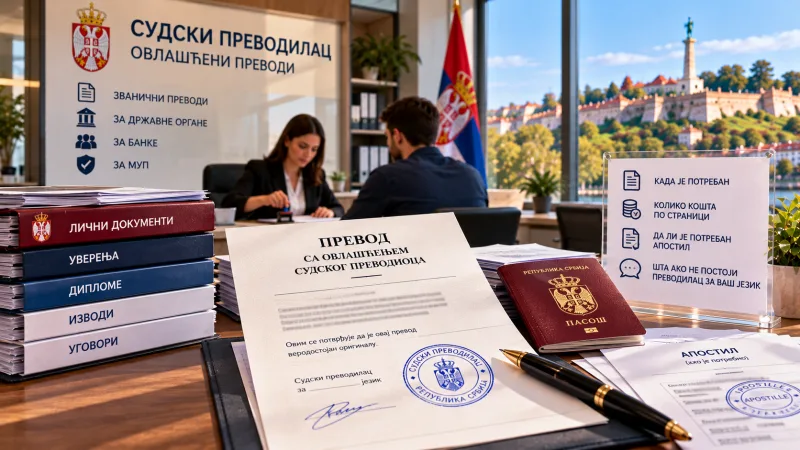
A court interpreter — sudski tumač — is the only one whose translation is accepted by Serbian state bodies: the MUP, banks, courts, notaries and the qualifications agency that handles nostrification. The interpreter's signature and stamp give the document legal force, so translations 'by a friend who knows Serbian' do not work here.
Where a translation is needed
The main cases: nostrification of a diploma and school certificate; applying for residence — marriage certificate, birth certificate, criminal record certificate; applying for permanent residence; a work permit and changing the ground of residence; exchanging a driving licence; and visiting a notary if you do not speak Serbian, because by law the notary requires a court interpreter to be present.
What it costs and how long it takes
A guide price is from 1,500 dinars per page, roughly 13 euros; a repeat copy of a finished translation is usually cheaper. Turnaround is one to five working days depending on the interpreter's workload, and often it is ready the next day. The original document is not needed: most interpreters accept a photo or scan by messenger or email.
Apostille: before the translation
An apostille or consular legalisation is placed on the original document in the country that issued it — that is, before translation in Serbia. If there is an apostille, it must be translated along with the document. Whether an apostille is needed at all depends on the issuing country: for documents from Russia, Ukraine and Belarus it is not required. Before applying, check this for your country so you do not pay unnecessarily.
What an interpreter will not do
They cannot 'fix' a surname to match your passport or change a category on a driving licence: the translation reflects exactly what the document says. Any discrepancies are resolved by the receiving body — the MUP, the qualifications agency or the bank — so trying to correct data at the interpreter only wastes time.
If there is no interpreter for your language
For some languages there may be no court interpreter in Serbia. In that case the route is: translate the document into English and have the translation certified by a notary in the issuing country, then in Serbia translate that English version into Serbian with a court interpreter.
What to do step by step
Work out which documents your procedure requires and whether an apostille is needed — before translating. Send scans to the interpreter and collect the finished translation. Settle the matter of originals in advance: at the MUP, in a bank and at nostrification the translation is usually kept, so ask for two certified copies or keep a scan. And keep translations in a separate folder — they will be needed again when you extend your status or change address.
Data checked on 11 October 2026: requirements for court translation and practice per the official register of interpreters and community experience.